State of Proptech Venture Capital: July 2026
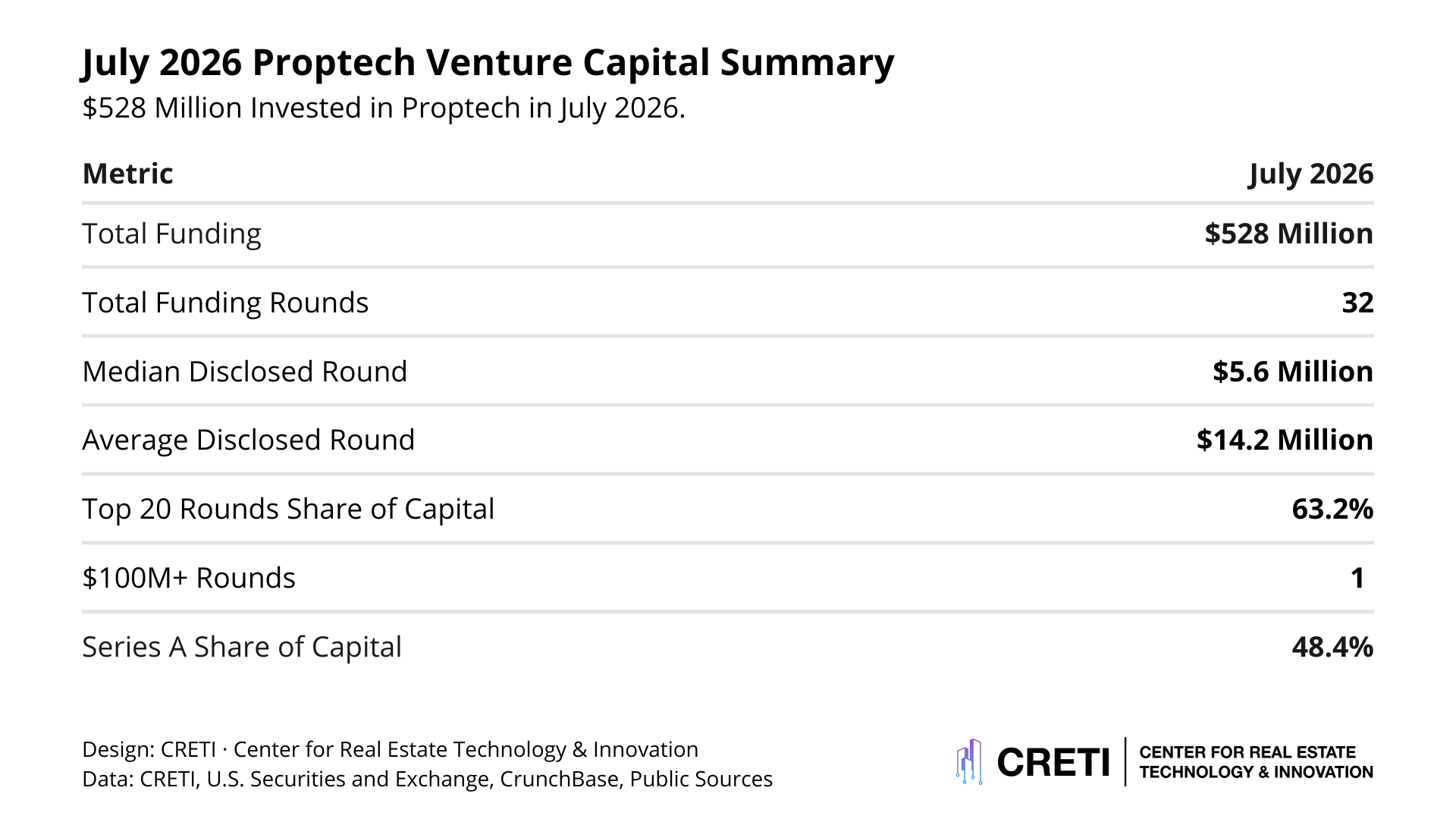
In July 2026, proptech companies raised $528 million across 32 funded companies, with a median funding round of $5.6 million. Compared with July 2025, when 49 companies raised $767 million, total funding declined 31.2% year over year, while deal activity fell 34.7%. Despite the pullback in overall capital, the median funding round increased from $5.0 million to $5.6 million, indicating that investors continued to concentrate larger investments in companies demonstrating commercial traction and scalable business models.
The month was characterized by a concentration of capital across a wide number of companies. Large financings in construction technology, residential platforms, and AI infrastructure accounted for a significant share of total investment by dollar volume, while early-stage activity remained active in workflow automation, sustainability, robotics, and operational software.
Overall, July reflected a venture market placing larger investments in companies that have been operational for five years or greater, while continuing to invest in earlier-stage companies.
Funding by Stage
Funding in July was concentrated overwhelmingly in Series A and Series B rounds, which together accounted for 89.1% of total capital deployed.
Series A financings led the month with $255.9 million, or 48.4% of total funding, driven by TerraFirma’s $115 million round, Gritt’s $26 million financing, and Axle Energy’s $24 million raise. Series B accounted for $215.0 million, or 40.7%, anchored by Dwelly’s $170 million financing package, which included $95 million in equity and $75 million in debt, alongside Monumental’s $32 million round.
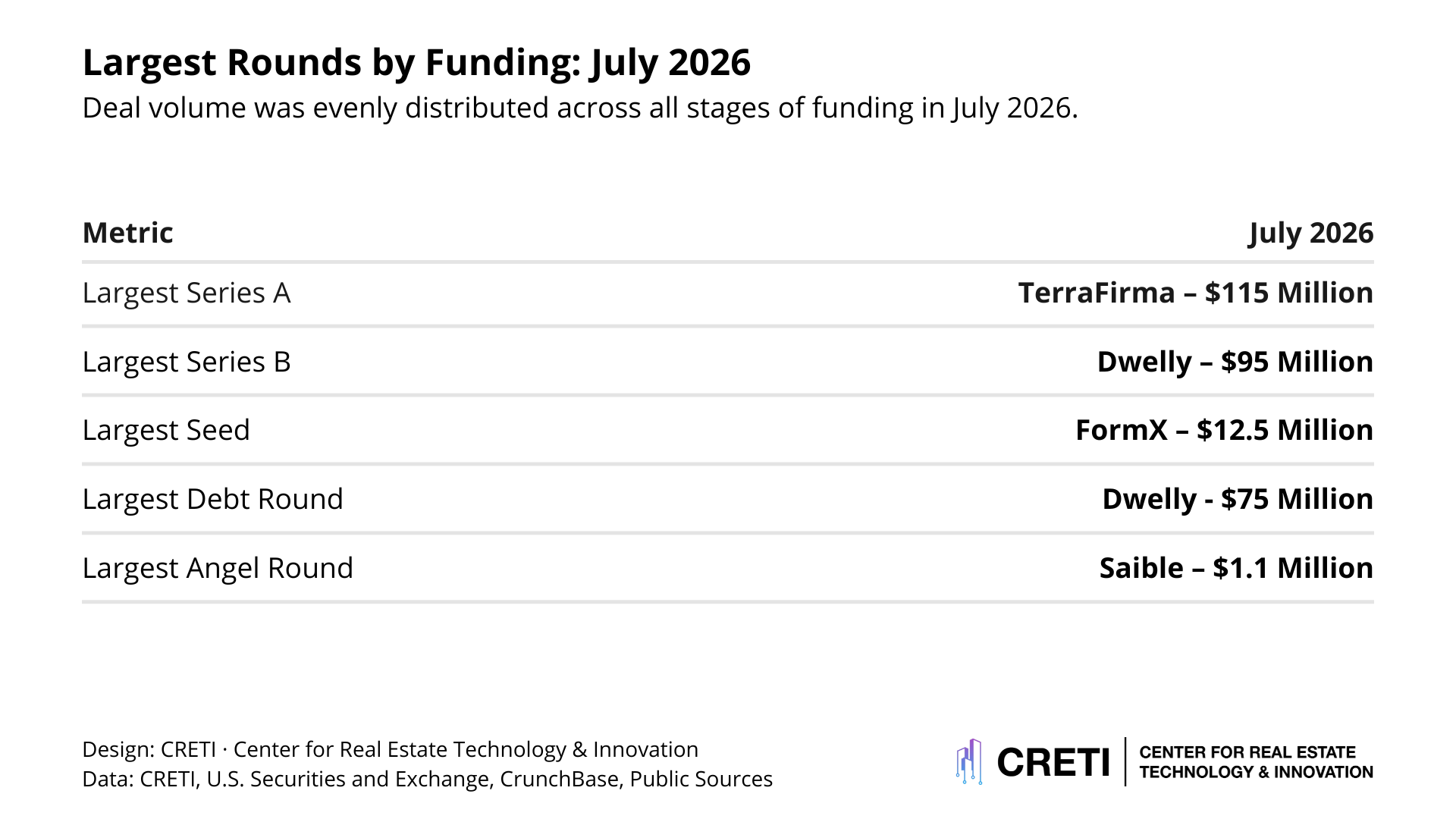
Early-stage activity remained broad but represented a much smaller share of total dollars. Seed funding totaled $48.4 million, or 9.2%, while pre-seed rounds accounted for $3.7 million, or 0.7%. Separately reported debt financings totaled $4.1 million, or 0.8%, and angel funding totaled $1.1 million, or 0.2%.
The distribution shows that July’s headline funding total was driven primarily by companies already entering or operating within the scaling phase. Early-stage investment remained active across construction, housing, energy, and real estate software, but the largest checks were reserved for companies with demonstrated traction and more developed commercial models.
Funding by Asset Class
Construction & Development: $260.2 Million (49.3%)
Construction and development represented the largest asset class during July, attracting $260.2 million, or 49.3% of total capital deployed.
The largest investments included TerraFirma ($115M), Monumental ($32M), and Gritt ($26M).
Additional funding flowed into AI-powered construction software, robotics, workforce management, modular construction, materials innovation, estimating, project controls, and sustainability technologies through companies including Buildforce, Prolo, Guthrie AI, Visibuilt, Rise Modular, ConstructionClock, Neutral Ground, Xylo, ZS2 Technologies, Saible, GreenVibe, METR, and dsb Deutsche Sanierungsberatung.
The allocation reflects continued investor conviction that construction remains one of the largest opportunities for productivity improvement within real estate. Rather than funding broad construction management platforms, capital was concentrated around technologies that improve project execution, engineering, robotics, workforce productivity, sustainability, and building performance.
Housing: $217.8 Million (41.2%)
Housing attracted $217.8 million, representing 41.2% of total capital deployed during July.
The largest financings included Dwelly ($170M), Keyper ($11M), and House of Student ($2M).
Dwelly's financing consisted of $95 million in Series B equity, led by EQT Growth, together with a $75 million debt facility provided by Trinity Capital, making it the largest financing announced during the month.
Additional investment supported residential property management, leasing, mortgage technology, rental operations, and resident services through companies including Muppy, Stylework, TaskHer, and iYell.
Housing remained one of the month's largest investment categories, reflecting continued investor confidence in platforms supporting the ownership and operation of residential real estate. The sector continues to benefit from recurring consumer demand, fragmented ownership, financing activity, and long-term operational needs, creating multiple opportunities for recurring revenue across the housing lifecycle.
Commercial Real Estate & Building Operations: $46.5 Million (8.8%)
Commercial real estate and building operations attracted $46.5 million in funding, accounting for 8.8% of total funding.
The largest financings included Henry ($16.5M), dili ($15M), and Agave ($15M).
Capital was directed toward AI-enabled brokerage workflows, property intelligence, underwriting automation, integrations, and commercial real estate operations rather than transaction marketplaces.
The allocation reflects continued investor demand for technologies that improve decision-making, automate knowledge work, and streamline operational workflows across commercial real estate. As transaction activity remains below historical levels, investors continue favoring platforms that improve productivity and asset performance for owners, operators, brokers, and lenders.
Financial Services: $3.5 Million (0.7%)
Financial infrastructure accounted for $3.5 million, or 0.7% of total disclosed capital.
The category was led by Tokenized Green ($1.3M) and iYell ($1.9M debt), representing investment in mortgage technology, financing infrastructure, and tokenization platforms supporting real estate transactions.
While financial infrastructure represented a relatively small share of total funding during July, the category continues to attract investment because these platforms sit directly within the movement of capital, financing, and financial data across the real estate ecosystem.

What This Means for Proptech
July's funding activity reflects a venture market that remains active but increasingly concentrated around companies demonstrating commercial traction and operational relevance.
Compared with July 2025, total funding and deal volume both declined. However, larger financings continued to emerge for businesses addressing fundamental challenges across construction, housing, and commercial real estate. The increase in median funding size suggests investors are deploying larger checks into fewer companies rather than retreating from the sector altogether.
Construction technology accounted for nearly half of all capital deployed during the month, reinforcing continued investor conviction in technologies that improve how buildings are designed, constructed, and maintained. Housing followed closely, driven primarily by Dwelly's $170 million financing, underscoring continued demand for platforms supporting residential ownership, leasing, and property operations.
Commercial real estate funding remained focused on operational software rather than transaction platforms. Investors continued backing companies using artificial intelligence to improve brokerage, underwriting, document analysis, and operational workflows—areas where technology can deliver measurable productivity gains regardless of transaction volumes.
The distribution of capital suggests that proptech investing continues to mature. Rather than pursuing broad platform narratives, investors are concentrating capital in businesses capable of improving execution, operational efficiency, and the long-term economics of real estate.