Case Study: Propera
When Underwriting Moves Into the Conversation
Residential real estate investing has always rewarded speed, but the economics of speed are changing. Investors, wholesalers, and agents increasingly compete for the same motivated sellers, lead costs continue to rise, and a homeowner may hear from dozens—or even hundreds—of prospective buyers before deciding whom to engage seriously. In that environment, the quality of an offer still matters, but so does the time it takes to produce one.
The bottleneck has traditionally been underwriting. A buyer can qualify a seller in minutes, but determining an after-repair value, selecting comparable sales, estimating repairs, applying a buy-box formula, and calculating a defensible offer can easily take another half hour. That forces a second interaction with the homeowner, creating a gap between when the seller becomes interested and when the investor is actually prepared to transact.
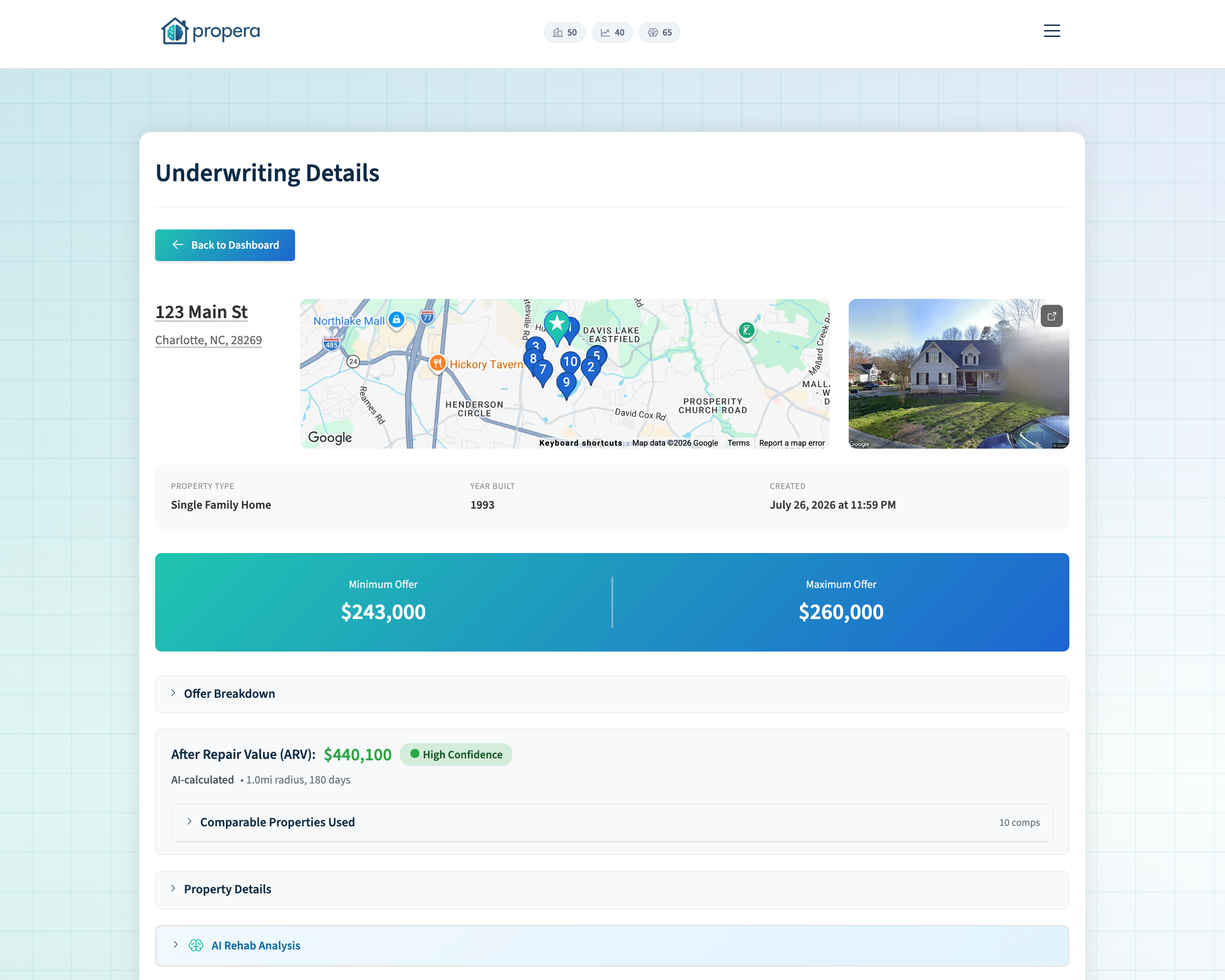
This case study explores the future of residential underwriting through the lens of one company attempting to close that gap. Propera is an AI-powered underwriting platform that turns a property address and seller conversation notes into a comparable-backed after-repair value, repair estimate, and customized cash offer range in under a minute. More broadly, the company represents a shift from underwriting as a back-office exercise to underwriting as something that can occur within the seller conversation itself.
The Second-Call Problem
The traditional residential acquisition workflow has barely changed in a decade. An investor calls a homeowner, qualifies the opportunity, records the property's condition, hangs up, opens a comparable-sales platform, calculates an ARV, estimates repairs, applies an acquisition formula, and schedules another call to deliver the offer. Each individual task is manageable, but together they create friction precisely where momentum matters most.
That second call is more consequential than it appears. A motivated seller who was receptive at 10:00 a.m. may have spoken with ten additional buyers by lunchtime, and there is no guarantee they answer when the original investor calls back. Follow-up should ideally be spent negotiating terms and building trust, not delivering a number that could theoretically have been produced while the seller was already on the phone.
The problem becomes even more pronounced at scale. If underwriting takes thirty minutes per property, a single acquisition professional can only evaluate so many opportunities each day. Increasing throughput has historically required additional analysts, more acquisitions staff, or a willingness to spend less time on individual deals. In a market where lead generation is expensive, all three options create pressure somewhere else in the business.
The Judgment Bottleneck
Residential underwriting is often described as a data problem, but much of the work is actually a matter of judgment. Platforms such as the MLS, PropStream, Zillow, and other data sources can provide comparable sales, yet the user still has to decide which comps matter, how heavily to weight them, and what the differences imply for value. The same is true of repairs, where estimates often depend on experience, memory, and a handful of notes collected during a seller conversation.
That creates another problem: bias. Investors naturally want deals to work, and comparable selection can drift toward transactions that support the desired outcome rather than the most defensible one. A renovated house a few streets away may look attractive as a comp, but subtle differences in location, condition, lot characteristics, or buyer behavior can materially change what the subject property is actually worth.
Repair estimates introduce similar uncertainty. A seller saying that the kitchen is original, the roof was replaced two years ago, and the HVAC struggles during summer contains meaningful underwriting information, but translating that language into a line-item budget is labor-intensive. Until recently, software was poorly equipped to understand messy human descriptions well enough to automate that process.
The Propera Story

Richard Okoro built Propera after experiencing these problems firsthand. He started his first real estate business at seventeen and, during the early months of COVID, convinced four high school friends to pool $1,000 to launch Northstate Equity. Over the following years, the company closed thirteen transactions across single-family homes, mobile homes, townhomes, land, and commercial warehouses, giving Okoro firsthand exposure to the repetitive underwriting work that accompanies residential acquisitions.
Okoro later attended the University of North Carolina at Chapel Hill as a Morehead-Cain Scholar, graduating in 2024 with a degree in computer science and a minor in entrepreneurship. Rather than approaching residential real estate as an outsider building software for an unfamiliar workflow, he entered software through a problem he had already lived as an investor. Propera was built around a deceptively simple question: what happens if the offer can be ready before the seller conversation ends?
That question became more practical as three technological changes converged. Property and transaction data became increasingly accessible through APIs rather than remaining locked in traditional listing systems. Large language models have become capable of interpreting unstructured notes with sufficient nuance to extract property condition and repair requirements. At the same time, webhooks and low-code integration tools have made it possible to insert new software directly into existing acquisition workflows rather than asking teams to replace their CRMs.
Underwriting in Sixty Seconds
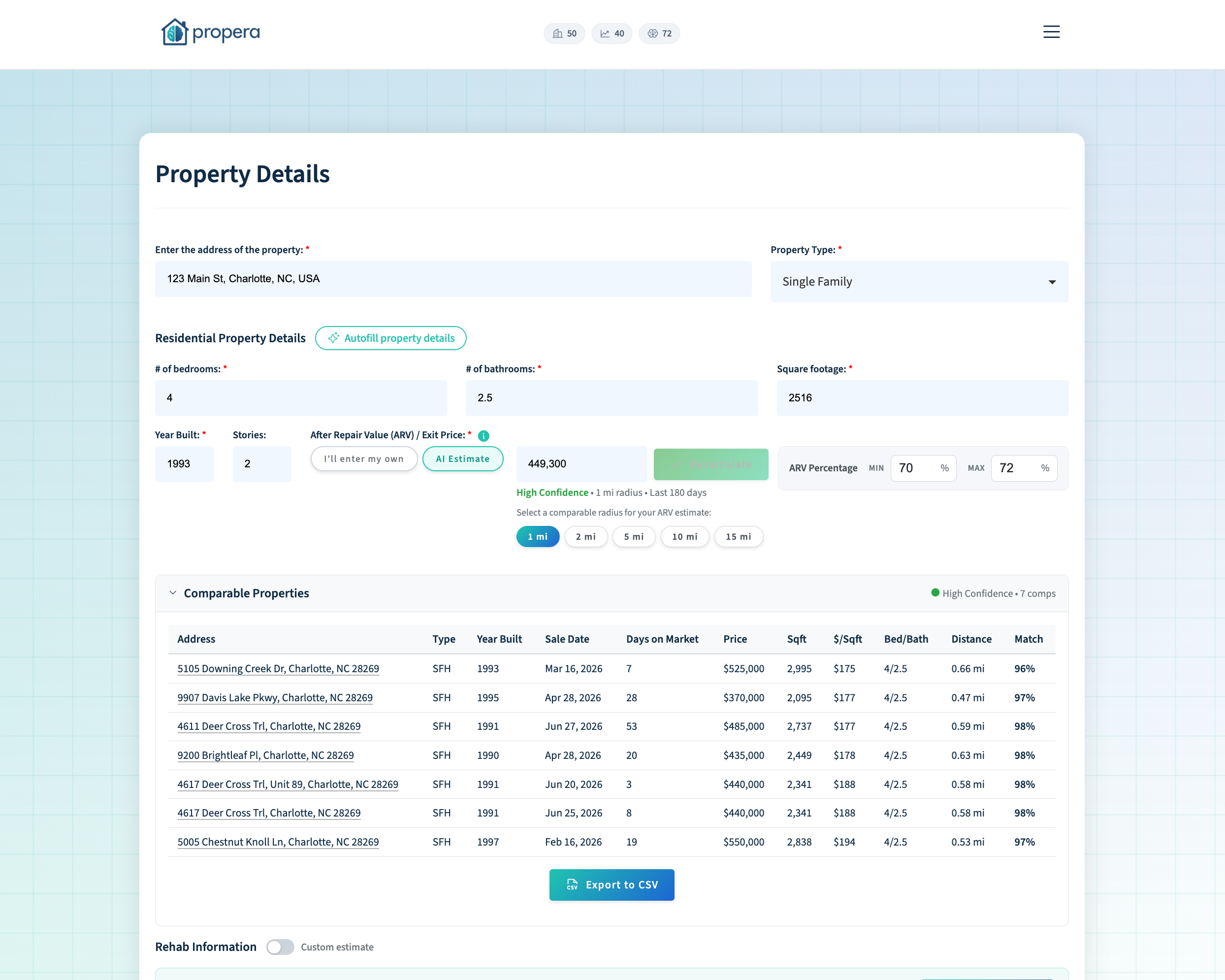
The Propera workflow begins with two inputs: a property address and notes from a conversation with the homeowner. The platform fills in property information, identifies comparable sales through its valuation model, generates an after-repair value, interprets the seller's description of the property's condition, and creates a repair estimate. It then applies the user's acquisition formula to produce a cash-offer range.
The important distinction is not simply that the calculation happens faster. The product is designed around the natural sequence of a seller conversation, allowing an acquisition professional to gather information and underwrite the opportunity simultaneously. One beta user described the experience by saying that the application could effectively be used as a call script because the information Propera needs mirrors the questions an investor would already ask a homeowner.
For solo investors, that means the application can remain open while they speak directly with sellers. Larger teams can take a different approach, triggering an underwrite from inside an existing CRM and automatically returning the ARV, comparable sales, and offer information to the lead record. The ambition is not to introduce another destination into an already fragmented software stack, but to make underwriting available wherever the acquisition professional already works.
From Raw Data to a Number
Many residential data products stop at the information retrieval stage. They provide property records, comparable transactions, maps, or estimated values, leaving the user responsible for deciding what that information means. Propera is attempting to move one step further by converting raw property data into an actionable acquisition decision.
That difference matters because the actual deliverable in residential acquisitions is not a spreadsheet. It is an offer. Comparable sales, repair budgets, and valuation methodologies are intermediate steps whose purpose is ultimately to answer one question: at what price does this deal make sense?
Propera's customizable buy-box formula preserves an important element of investor judgment. Different operators have different return requirements, construction capabilities, financing costs, and market strategies, so there is no universal definition of a good deal. Rather than replacing that investment philosophy, the platform attempts to automate the mechanical work required to apply it consistently.
Speed Without Giving Up the Number
Automation is valuable only if the resulting number can be trusted. In residential acquisitions, shaving twenty-nine minutes from underwriting has little value if the investor systematically overpays. Propera's early customer testing has therefore focused heavily on comparing its output against deals and markets that experienced operators already understand.
One early user, Luke, initially ignored requests to test the product. Okoro eventually ran one of Luke's historical deals through Propera and sent him the result. On that property, the experienced investor associated with the deal had set a maximum allowable offer of $110,000, Luke's own manual underwriting produced $90,000, and Propera returned a range of $99,000 to $124,000. According to Luke, the rehabilitation estimate was also closely aligned with what the property ultimately required.
Another user, Edgar, took a Propera-generated offer into a live transaction and had the seller accept it without pushback. Harris, a fix-and-flip investor, tested the platform against properties he knew well, including his own previous projects, and concluded that the valuations were sufficiently accurate to serve as a first pass on prospective deals. These examples remain early, but they speak directly to the product's central premise: the output has to be fast enough to use live and credible enough to put real capital behind.
More Offers per Person
The most obvious benefit of compressing underwriting from thirty minutes to less than sixty seconds is capacity. An acquisitions professional can evaluate more leads in a day without adding another analyst, and a small operator can compete with larger organizations without replicating their staffing model. But the larger impact may come from collapsing two seller interactions into one.
If a legitimate offer can be produced while the homeowner is still on the line, the second call changes purpose. Instead of trying to reconnect simply to communicate a price, the acquisition professional can use subsequent conversations to negotiate, answer objections, and move toward closing. Automation shifts human time away from calculation and toward persuasion.
That is an important distinction because residential acquisition remains a relationship business. Sellers are not simply data records moving through a funnel; many are facing financial pressure, inherited properties, deferred maintenance, relocation, or other complex circumstances. The most valuable use of AI may therefore be to remove the mechanical work surrounding the conversation, so that humans can spend more time on the parts of the transaction that require judgment and trust.
Agents at the Acquisition Desk
Propera's longer-term vision extends beyond underwriting. Residential acquisition is moving toward workflows in which software increasingly handles lead intake, qualification, valuation, follow-up, and administrative work, while acquisition professionals intervene when relationships, negotiation, or complex judgment become necessary. In that model, today's underwriting tool becomes one component of a larger agentic acquisition system.
The implications extend beyond investors and wholesalers. Real estate agents also need fast valuation, especially when helping investor clients or pricing properties that require substantial renovation. Builders, lenders, and attorneys operate around many of the same property-level decisions, suggesting that increasingly sophisticated valuation and underwriting models could eventually become embedded across a much larger portion of the residential transaction ecosystem.
Hyperlocal accuracy remains one of the industry's harder challenges. The difference between two neighborhoods, two blocks, or even opposite sides of the same road can influence what a renovated property is worth, and no automated model has fully eliminated the need for local judgment. The likely future is therefore not one in which software completely replaces experienced operators, but one in which experience becomes amplified by systems capable of doing far more of the repetitive analytical work.
The Economics of Speed
Propera became publicly available in May 2026 after a beta period in March and April, during which users tested the platform on real acquisition opportunities. The company generated paying subscribers within its first weeks of launch and has remained bootstrapped, with Okoro building and operating the business without outside capital. Its early benchmarking includes a fixed set of 50 recent property sales to assess valuation accuracy, along with feedback from experienced fix-and-flip investors.
Those metrics are still early, and the company is at a very different stage from venture-backed platforms operating at institutional scale. But its emergence illustrates a broader trend across real estate software. AI is lowering the cost of turning specialized human workflows into software, allowing very small teams—and sometimes individual founders—to attack processes that previously required significantly more capital and engineering resources.
Residential underwriting is a particularly interesting example because speed has direct economic value. Every minute removed from underwriting increases potential throughput, while every eliminated seller callback removes another point at which the deal can disappear. The product therefore competes not only on software efficiency, but on whether faster decision-making ultimately produces more signed contracts.
The Real-Time Acquisition Firm
Residential investors have historically differentiated themselves through sourcing, local knowledge, access to capital, and the judgment required to recognize a good deal quickly. AI does not eliminate those advantages, but it changes how quickly they can be applied. What once required a desk, several browser tabs, and thirty minutes of analysis can increasingly happen while the seller is still explaining why they want to move.
That changes the competitive unit of the acquisition business. The question becomes less about how many analysts an organization can hire and more about how many high-quality decisions each acquisition professional can make. As underwriting, qualification, and administrative work become automated, the human role moves further toward negotiation, relationship-building, and judgment.
Propera is one early example of that transition. The company is not simply attempting to make a spreadsheet faster; it is attempting to remove the gap between information and action. If that model proves durable, residential acquisitions may increasingly operate in real time, with underwriting happening alongside the conversation rather than after it.
For years, the fastest buyer often had an advantage. AI may make speed far more widely available. The harder question—and ultimately the more valuable one—will be who can combine that speed with judgment accurate enough to act on it.
Learn more about Propera at getpropera.com