Case Study: QuietScore
The Missing Performance Metric in Multifamily
Multifamily housing has become increasingly measurable. Renters can compare rents, floorplans, commute times, amenities, neighborhood demographics, online reviews, and even the restaurants and grocery stores within walking distance of an apartment. Owners, meanwhile, track occupancy, renewal rates, maintenance response times, utility consumption, resident satisfaction, and dozens of other indicators intended to explain how a property is performing.
Yet one of the characteristics residents experience most directly remains largely invisible until after move-in: how well the building contains sound. A prospective renter can tour an apartment in the middle of the afternoon and inspect nearly every visible feature of the unit, but still have little idea whether they will hear footsteps from above, conversations through an adjoining wall, televisions from the neighboring unit, or doors closing down the hallway. By the time they learn the answer, they may already be twelve months into a lease.
This case study explores the emerging category of acoustic intelligence through one company attempting to make that performance more visible. QuietScore is developing an AI-powered platform that analyzes construction records, architectural information, property characteristics, resident experiences, and other building-level evidence to estimate likely interior acoustic performance. More broadly, however, the company represents an interesting question for multifamily: if the industry can measure almost every other dimension of the resident experience, why has sound remained so difficult to understand?
The Noise You Cannot Tour
The apartment search process is built around information that can be observed before the transaction. A renter can inspect finishes, measure the bedroom, test the commute, tour the gym, compare rents, and study neighborhood reviews before signing a lease. Even relatively subjective qualities such as natural light, views, or the feel of a neighborhood can usually be experienced firsthand.
Interior noise behaves differently. Many of the conditions that determine whether an apartment feels quiet depend on what happens when neighboring units are occupied, residents are walking overhead, televisions are running, doors are closing, or daily life is taking place on the other side of a wall. A thirty-minute tour provides an incomplete sample of a building that the resident may occupy for thousands of hours over the following year.
That information gap matters because acoustics touch several of the things multifamily operators spend heavily to improve: sleep, privacy, concentration, resident satisfaction, and ultimately retention. A luxury lobby or high-end fitness center can be photographed and marketed immediately. Sound isolation is harder to demonstrate, even though poor performance can shape a resident's experience every night after the leasing team has gone home.
The Evidence Problem
The industry is not entirely blind to acoustics. Buildings contain clues about likely performance, from structural systems and wall assemblies to construction era, permits, architectural documentation, resident complaints, and professional acoustic testing. The challenge is that those clues live in different places and vary enormously in quality.
Renters tend to rely on broad shortcuts. Newer construction must be quieter. Concrete buildings must perform better than wood-frame buildings. A handful of complaints in an online review may imply that a property has a noise problem. Each assumption may contain some useful signal, but none provides a standardized way to compare one property with another.
Owners confront the same problem at portfolio scale. Acoustic issues may surface through resident complaints or management escalations, while more definitive answers can require professional acoustical review and field measurement. That expertise remains essential, but conducting detailed testing across thousands of units and properties is not necessarily practical as the first step in understanding where risk may exist.
QuietScore is positioning itself between those two extremes. The objective is not to replace acoustical engineers or field testing, but to determine what can reasonably be inferred from the evidence already available, how confident that inference should be, and where more specialized investigation is warranted.
The QuietScore Story

QuietScore was founded by Clayton O'Leary around a deceptively simple observation: renters can evaluate almost every major feature of an apartment before signing a lease except how the building is likely to sound once they live there. O'Leary came to the problem from more than a decade in telecommunications sales and leadership, where much of his work centered on understanding customer needs, developing relationships, and bringing products to market.
Rather than beginning with a traditional acoustical-testing business, QuietScore started with the information problem. The company is attempting to gather fragmented evidence about multifamily buildings and translate it into a standardized view of acoustic risk that can eventually serve both consumers and real estate professionals. O'Leary leads product vision, commercialization, partnerships, and customer discovery while working with specialists in acoustics, engineering, and applied modeling to advance the technical validation of the platform.
That distinction is important because acoustics is not a field where confidence should be manufactured simply because software can generate a prediction. QuietScore's longer-term technical objective explicitly includes reasoning across incomplete and sometimes conflicting evidence while representing uncertainty rather than forcing a definitive score when the underlying information does not support one. In a category built around technical building performance, knowing when not to make a claim may ultimately be as important as making one.
Teaching AI to Read Buildings
Recent advances in multimodal AI make the category more technically feasible than it would have been only a few years ago. Construction information exists in permits, plans, technical documents, imagery, property databases, resident reviews, and other sources that historically required substantial manual research to reconcile. Modern document understanding and information retrieval systems can process much larger volumes of that fragmented evidence and begin identifying relationships across sources.
The opportunity extends beyond determining whether a building is simply old or new, concrete or wood frame. Acoustic performance emerges from combinations of assemblies, construction practices, geometry, materials, building systems, and real-world execution. Two properties that appear similar from a listing page may therefore perform very differently once occupied.
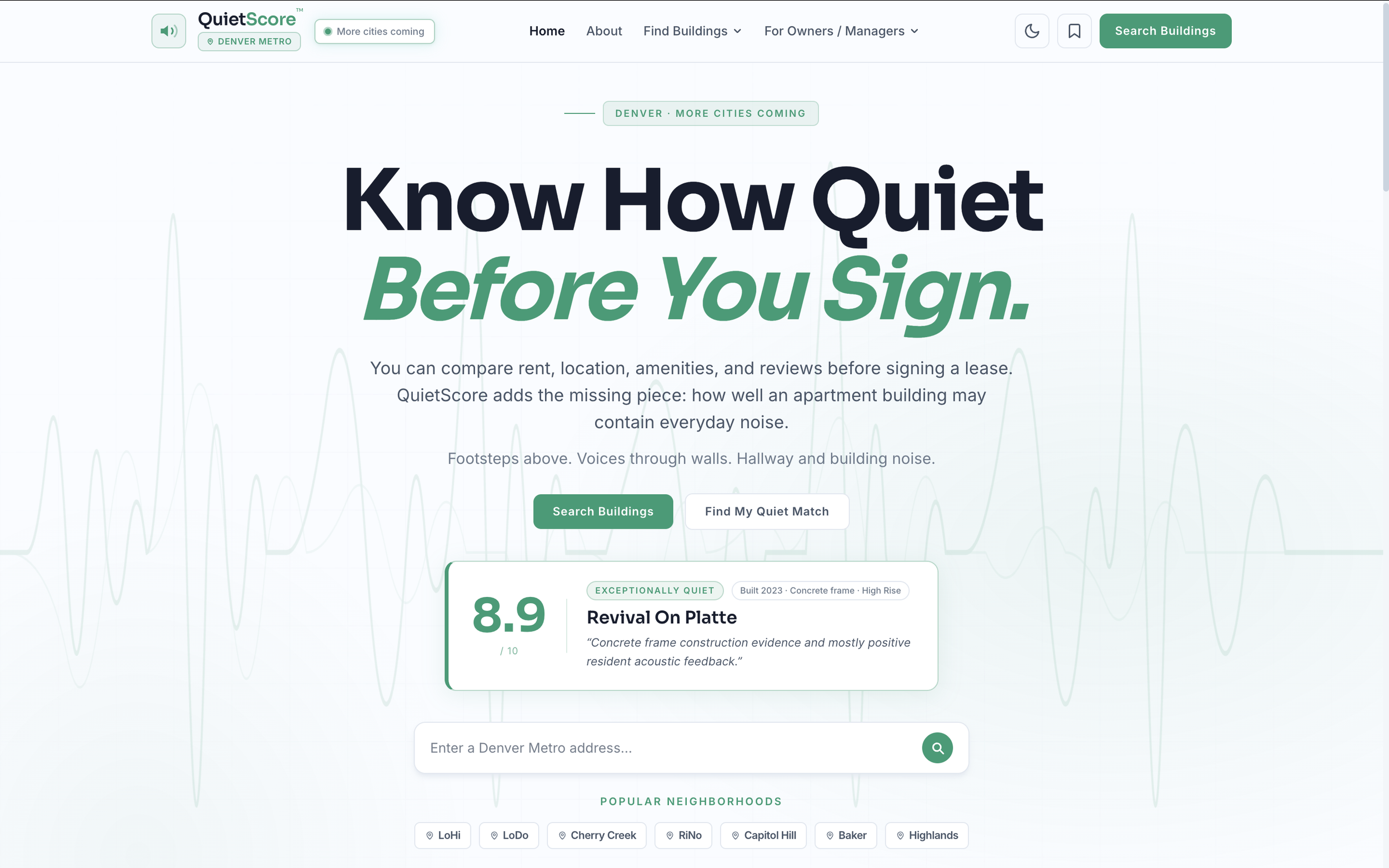
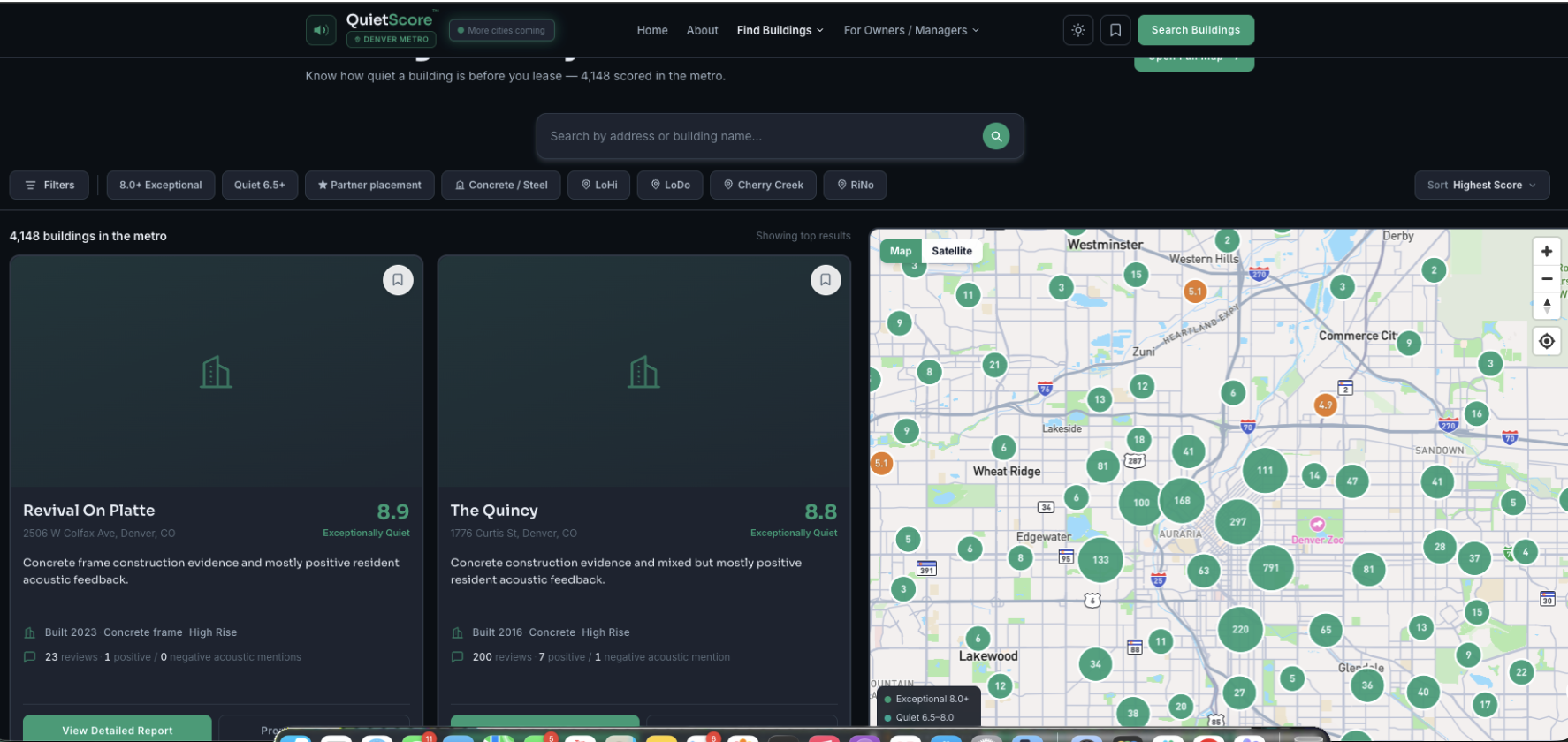
QuietScore is developing a methodology intended to reason across those signals rather than rely on a single proxy. The company's public product already presents score components tied to areas such as construction evidence, resident signals, building type, permits, and complaint information, making the inputs behind an assessment more visible rather than reducing the entire building to an unexplained number.
This is where uncertainty becomes important. A consumer score can create a false sense of precision if the underlying evidence is weak, particularly in a technical category where field conditions matter. QuietScore's more interesting ambition is therefore not merely producing a rating, but creating an evidence layer that can communicate both what is known and how strongly it is known.
From Renter Search to Building Intelligence
QuietScore's current public platform covers more than 3,500 multifamily buildings in the Denver market. Renters can search properties and review building-level information designed to help them better understand potential acoustic performance before signing a lease. The consumer application also gives the company a distribution channel through which awareness of acoustic transparency can develop from the resident side of the market.
Behind that experience sits a potentially larger professional use case. Owners and operators could use similar intelligence to identify buildings or areas of a portfolio that deserve deeper acoustic investigation, prioritize where professional testing may create the most value, and reduce the manual research required to understand construction and acoustic risk across large numbers of properties.
That is a very different proposition from simply publishing apartment scores. If the underlying system becomes sufficiently validated, the renter-facing product could ultimately become one interface into a broader building-performance dataset used by operators, developers, asset managers, property-data providers, and other participants in the real estate ecosystem.
The company is careful about where it stands today. QuietScore is pre-revenue and still in the commercialization and validation stage, with no claimed customer ROI or validated acoustic-performance outcomes. Its next phase depends on owner/operator pilots and professional validation partnerships capable of testing whether the intelligence produced by the platform corresponds closely enough with real-world building performance to support higher-stakes decisions.
The Expert in the Loop
AI has a tendency to create narratives about professional replacement. In acoustics, that framing misses the more practical opportunity.
Professional acoustical testing remains the authoritative method for understanding real-world sound transmission, and QuietScore does not present its platform as a substitute for that expertise. Instead, the model resembles a triage layer: use existing information to identify where potential issues may exist, determine how much confidence can reasonably be placed in that assessment, and direct scarce professional attention toward the places where it is most valuable.
That could become increasingly useful at portfolio scale. An owner with dozens or hundreds of multifamily properties cannot necessarily commission comprehensive acoustic testing everywhere simply to establish a baseline. An intelligence layer capable of narrowing the field could make specialized engineering expertise more scalable without pretending software can replace measurement.
QuietScore has incorporated that philosophy into its advisory structure. Alan Burt, P.E., Managing Partner of SSA Acoustics, advises the company on building assemblies, acoustic standards, field-testing methodology, and technical validation, while longtime multifamily executive Nigel Keenan contributes approximately thirty years of real estate experience and more than $3 billion in transaction experience to the company's industry strategy.
Acoustics as Resident Experience
For multifamily owners, the business case for acoustic intelligence will ultimately depend on whether it connects to measurable property outcomes. Noise complaints alone are unlikely to create a new data category. The more interesting question is whether acoustic performance can eventually be linked to leasing confidence, resident satisfaction, retention, reputation, or capital-improvement decisions.
A standardized acoustic layer could give operators another way to understand why otherwise similar properties perform differently. If one building generates persistent resident dissatisfaction despite strong amenities and responsive management, acoustic conditions may be part of the explanation. Conversely, a property with demonstrably strong sound isolation could potentially turn an invisible construction characteristic into a point of differentiation.
Developers could benefit from a different feedback loop. Buildings are designed to specifications, but owners rarely receive standardized post-occupancy intelligence showing how acoustic choices actually perform across large numbers of completed properties. A sufficiently robust dataset could eventually connect design assumptions with real-world resident experience, creating information that flows backward into future development decisions.
The operative word is eventually. QuietScore has not yet demonstrated those outcomes commercially, and proving the connection between inferred acoustic performance and resident or asset-level economics will require careful validation. But that is precisely what makes the category worth watching: a previously invisible aspect of building quality is beginning to become something software can at least attempt to observe systematically.
The Transparency Layer
Housing has followed a broader consumer trend toward increasingly granular information. Travelers compare hotels using thousands of reviews. Drivers can evaluate safety ratings before buying a car. Consumers can research everything from restaurant noise levels to mattress firmness before spending relatively small amounts of money.
Renting an apartment is a much larger commitment, yet several dimensions of actual housing quality remain difficult to evaluate before move-in. Acoustic performance is perhaps one of the clearest examples because its impact can be substantial while its visibility during the transaction remains low.
If reliable acoustic intelligence emerges, renters may eventually come to expect it rather than view it as a specialty metric. That creates an interesting incentive for owners as well. Transparency can initially feel uncomfortable when a new performance measure becomes visible, but properties that perform well gain a way to demonstrate quality that competitors cannot easily imitate with cosmetic upgrades.
Over time, that dynamic could move acoustics from a complaint-management issue to a component of asset positioning. The strongest buildings would have evidence supporting their performance, weaker buildings would gain clearer signals about where intervention may be required, and renters could make decisions with information that currently becomes available only after moving in.
Making the Invisible Measurable
QuietScore remains at an early stage. The company is founder-funded, is currently raising a $250,000 pre-seed SAFE, and has built its initial market around Denver while pursuing pilots and technical validation. Its early milestones include analyzing more than 3,500 multifamily buildings, developing its scoring and AI-assisted research platform, filing a U.S. patent application, and establishing advisory relationships spanning multifamily operations and acoustical engineering.
The larger thesis, however, extends well beyond one startup. Real estate technology has spent years making visible things easier to search, compare, and optimize: rents, amenities, locations, transactions, energy consumption, occupancy, and operating performance. AI increasingly opens the possibility of doing the same for building characteristics whose underlying evidence is scattered across documents, images, technical records, and human experience.
Acoustics is an unusually compelling test case because the gap between importance and transparency is so wide. Residents experience sound every day, owners absorb the consequences when it performs poorly, and yet neither side has had a scalable method for understanding it consistently.
The future QuietScore is betting on is one in which acoustic performance becomes another standardized layer of property intelligence. Getting there will require validation, professional collaboration, and careful treatment of uncertainty, particularly because a score can never be more reliable than the evidence underneath it. But if the category develops as envisioned, one of the most subjective questions in apartment hunting may eventually become much more objective: not whether a building looks quiet during a tour, but how likely it is to stay that way after the front door closes.