State of Proptech Venture Capital: August 2026

Key Takeaways
Capital moved closer to the physical asset. Construction & Development, Energy & Infrastructure, and Residential accounted for the vast majority of August funding, showing stronger investor conviction in technologies tied to development, power, housing, and asset performance.
Construction remains the clearest productivity thesis. Investors are backing technologies that can reduce labor requirements, improve schedule certainty, lower rework, and make project costs more predictable, creating a direct link between technology adoption and development economics.
Commercial real estate tech attracted almost no capital. Commercial real estate technology received just $1.0 million in August, suggesting investors currently see larger opportunities in areas where technology can influence whether an asset can be built, what it costs, and how efficiently it performs.
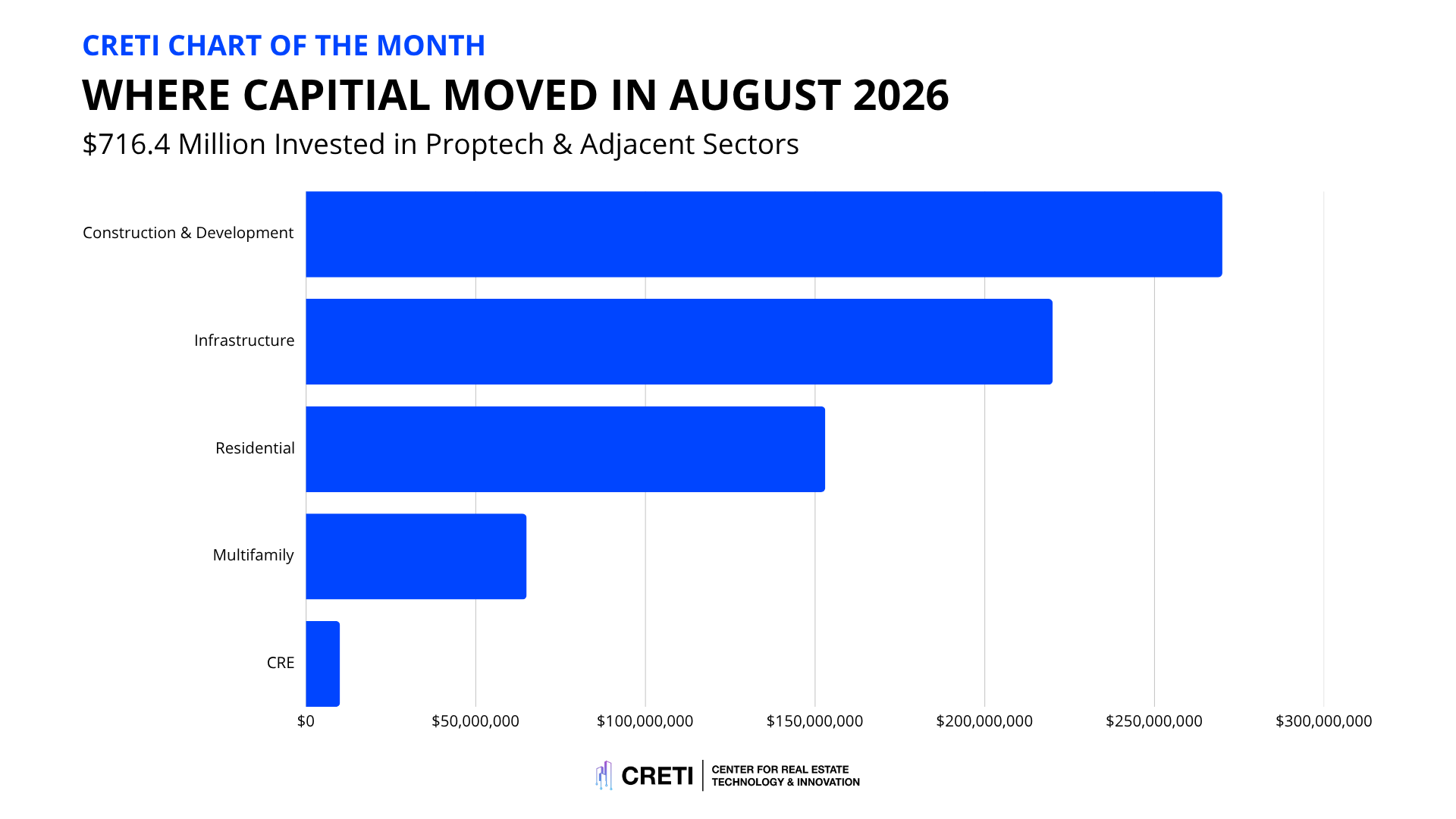
Proptech venture capital remained active in August, but the month was defined more by concentration than breadth. CRETI tracked $716.4 million in funding, with the largest pools of capital flowing into construction, energy, residential, and multifamily technology rather than traditional commercial real estate software.
Construction & Development led the month with $270.1 million, followed by $215.0 million in Energy & Infrastructure and $153.2 million in Residential. Multifamily accounted for $70.1 million, while Commercial Real Estate attracted just $1.0 million and another $6.1 million fell into adjacent categories.
Construction Is Becoming a Productivity Investment
Construction & Development was the largest funding category in August, with capital spread across 3D printing, robotics, advanced materials, procurement, project intelligence, and construction software. ICON raised approximately $114.9 million, while Reframe Systems raised $40 million, CivilGrid raised $26 million, and Digs raised $25.3 million.
The investment case is becoming less about digitizing construction and more about improving productivity. Developers and contractors continue to face labor constraints, elevated costs, and schedule risk, which increases the value of technologies that can reduce rework, improve coordination, shorten development timelines, or make project costs more predictable.
For owners and developers, those outcomes can be translated directly into project economics. A shorter construction schedule can reduce carrying costs and accelerate revenue, while greater labor productivity and cost certainty can improve basis and development yield.
That is what makes construction technology particularly attractive in the current market. The strongest companies are not simply replacing spreadsheets or improving communication; they are attempting to change how efficiently physical assets are delivered.
Energy Is Moving Into the Real Estate Investment Case
Energy & Infrastructure attracted $215.0 million in August, led by Invenergy. The company sits closer to energy infrastructure than traditional proptech, but its relevance to real estate reflects a broader shift in how owners and developers are thinking about power, site feasibility, and operating performance.
For data centers, advanced manufacturing, industrial facilities, and other energy-intensive uses, access to reliable power can influence where a project gets built and whether the economics work at all. At the operating level, energy costs remain a meaningful component of expenses and therefore asset performance.
This pushes energy further into the underwriting process. What was once treated primarily as a facilities or sustainability consideration can now affect development feasibility, capital requirements, operating expenses, and long-term asset value.
The distinction between proptech and infrastructure is becoming less important than the economic outcome. For real estate executives, the more useful question is whether a technology or infrastructure solution can improve cost, risk, or asset performance.
Residential Remains a Large Venture Market
Residential technology attracted $153.2 million in August, reflecting continued investor interest in housing production, smart residential systems, brokerage technology, consumer platforms, and adjacent services.
The category remains attractive because the underlying problems are still large. Housing affordability, limited supply, financing costs, and transaction friction create opportunities for companies that can improve how homes are built, bought, financed, managed, or experienced.
Investor interest also appears to be moving toward more structural problems. Technology that can reduce housing production costs or improve transaction economics has a clearer value proposition than products focused primarily on incremental convenience.
That distinction matters. Residential technology continues to offer a large market, but investors are placing a higher bar on whether a company can solve a costly, recurring problem.
Multifamily Is Becoming More Financially Accountable
Multifamily attracted $70.1 million in August, with capital flowing into operating platforms, market intelligence, payments, access technology, and resident-facing systems.
The category has matured considerably, and the standards for adoption are becoming more financial. Owners are increasingly evaluating technology based on whether it can improve revenue, reduce staffing burden, lower operating expenses, strengthen collections, or improve portfolio-level decision-making.
ApartmentIQ’s $25 million Series C is representative of that shift. Its position in the operating and intelligence layer of multifamily reflects broader demand for platforms that can be measured against portfolio performance rather than treated as discretionary software spend.
For multifamily operators, this creates a clearer evaluation framework. Products that become embedded in core workflows and demonstrate measurable financial outcomes should be more defensible than platforms whose value remains difficult to quantify.
Commercial Real Estate Tech Was Nearly Absent
Commercial real estate technology attracted just $1.0 million in August, a sharp contrast with the capital flowing into construction, energy, residential, and multifamily.
One month does not establish a permanent trend, but the imbalance is notable. Many traditional CRE software categories already have established platforms across leasing, brokerage, underwriting, property operations, data, and investment management, making differentiation more difficult for new entrants.
Investors appear more willing to fund areas where the underlying problem remains expensive and unresolved. Construction productivity, housing supply, power availability, and infrastructure risk all affect the asset before many traditional software applications enter the picture.
This suggests venture capital is moving further upstream in the real estate lifecycle. Rather than concentrating only on software used after a property is operating, investors are increasingly backing technologies that influence whether the asset can be built, how much it costs, and how effectively it performs.
The Operating Implication for Real Estate
The shift in venture capital has implications beyond the startup market. As technology moves deeper into construction, energy, housing production, and physical systems, technology decisions increasingly belong with development, acquisitions, asset management, finance, and investment committees rather than sitting primarily with IT or innovation teams.
That changes how technology should be evaluated inside a real estate organization. A workflow tool may improve productivity within one department, while a construction or energy technology can influence the investment case for the asset itself.
For real estate executives, the evaluation framework should become more financially disciplined. Proptech companies deserve attention when they can demonstrate a measurable effect on revenue, operating expenses, development basis, capital requirements, risk, or asset performance.
CRETI’s Perspective
August’s funding activity provides a useful view into where venture investors see structural opportunity, particularly in construction, energy, housing, and operating technologies tied more directly to the economics of the asset. Funding can signal market size, investor conviction, and a company’s ability to attract resources, but it does not prove that a product will create value inside a specific real estate organization.
That distinction is important as executives face more technology choices and greater pressure to avoid expensive implementation mistakes. The strongest approach is to use venture activity as a filter for where the market is moving, then evaluate individual companies based on the business problem they solve, operating fit, implementation requirements, and measurable financial impact.
The next phase of proptech will be less about finding more technology and more about selective choice. Real estate organizations that benefit most will use market signals to narrow the field, test solutions against clear operating and financial outcomes, and scale only after the value is proven.