Proptech Jobs Market: Hiring Falls 58% as Companies Shift Toward Leaner Growth

The Proptech Jobs Market Is Contracting
Proptech companies appear to be entering a more defensive phase of the employment cycle.
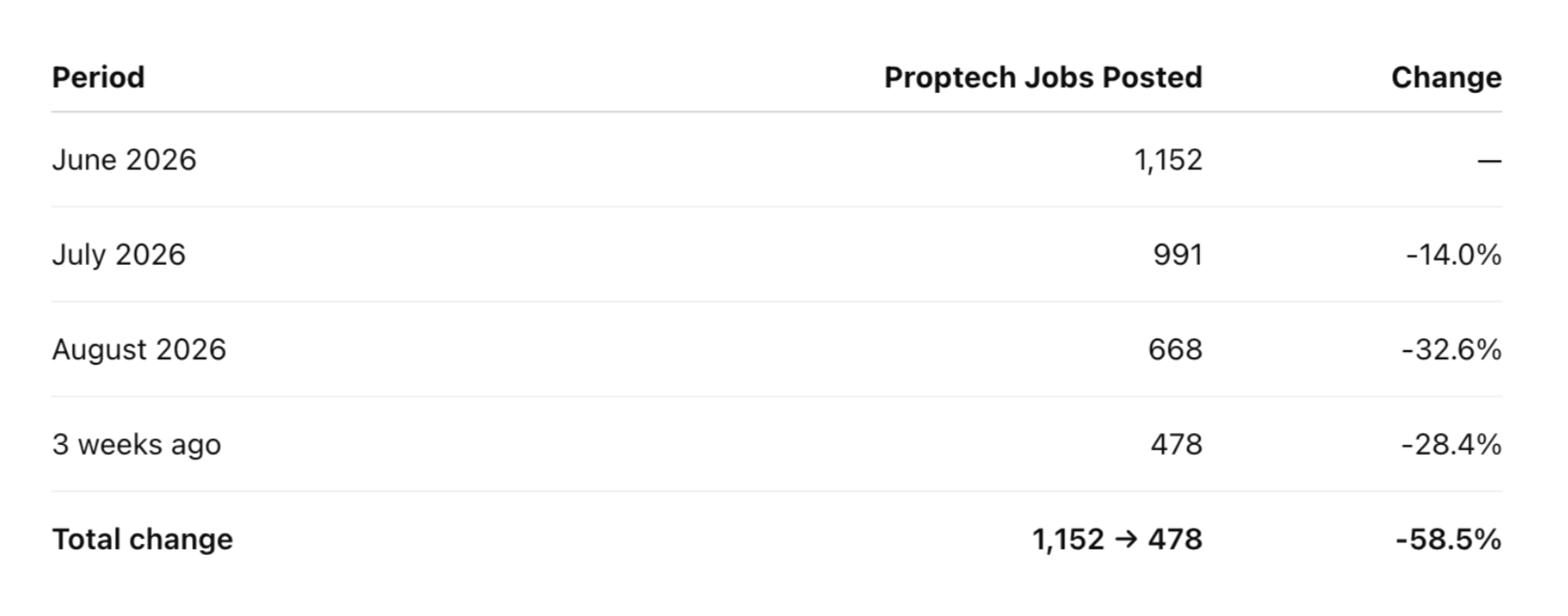
CRETI's tracking of open roles across CareerHound and LinkedIn shows a meaningful decline in advertised proptech jobs over the past three months:
Source: CareerHound & LinkedIn. CRETI analysis.
What the Data Is Telling Us
A nearly 59% decline in visible job postings over approximately three months is significant. More importantly, the decline accelerated rather than occurring as a single adjustment: postings fell 14% in the first comparison, followed by declines of approximately 33% and 28%.
The broader labor market has also softened, but proptech's contraction appears considerably sharper. That distinction suggests the industry is experiencing more than normal hiring cyclicality. Companies are increasingly prioritizing operating efficiency, revenue productivity and disciplined capital allocation over headcount expansion.
Where Proptech Was Hiring
Three months ago, the United States remained the largest identifiable proptech employment market in CRETI's geographic breakdown, with 370 open positions, followed by Europe with 271. Canada accounted for 35 positions and South America for 26.
Among the 702 jobs included in the geographic breakdown, the United States represented approximately 52.7%, while Europe accounted for 38.6%. Together, the two markets represented more than 91% of the geographically identified opportunities.
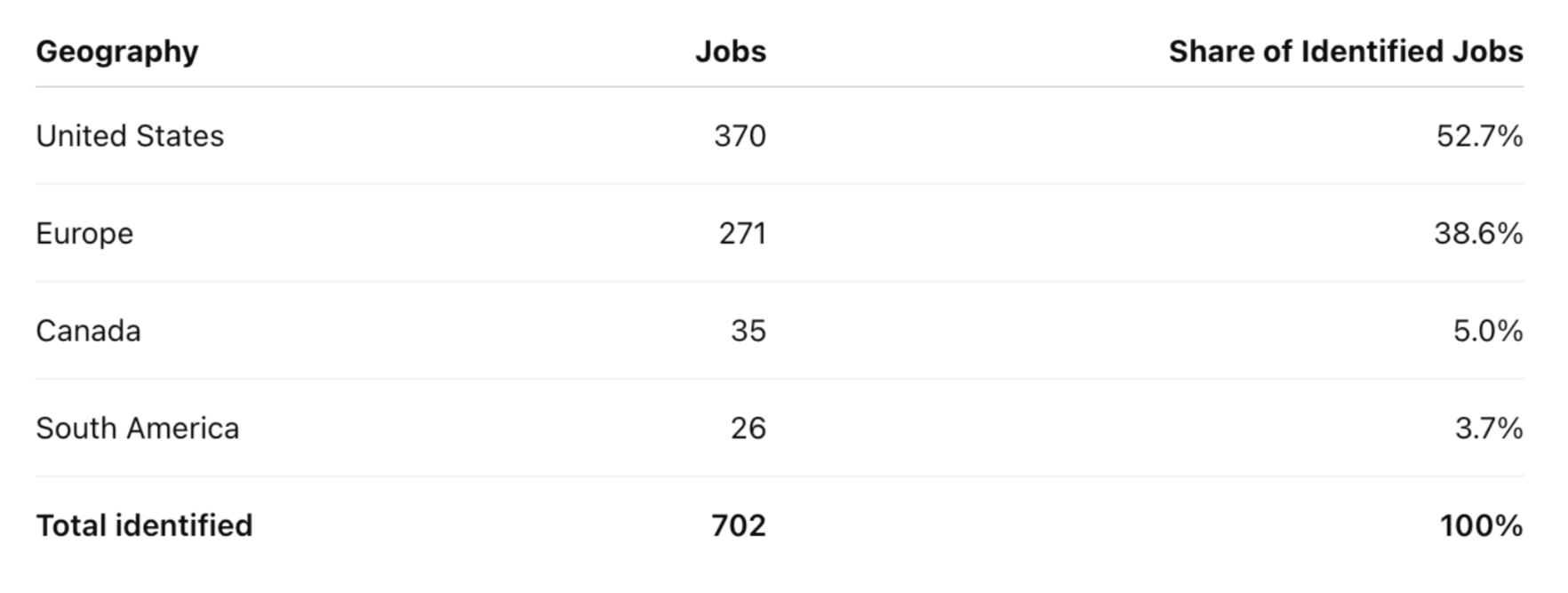
This concentration is notable because it reinforces where the industry's employment infrastructure remains deepest. The United States continues to lead, but Europe's sizable share indicates that proptech talent demand is not exclusively a U.S. phenomenon.
This Is Becoming an Operating-Leverage Story
For much of the last decade, headcount was frequently treated as a proxy for startup momentum. That model is changing.
Proptech companies are increasingly being pushed toward smaller teams, greater automation and higher revenue productivity per employee. Capital that might previously have supported another layer of marketing, operations or generalist hiring now has to compete with AI, outsourced services and technology capable of increasing output without additional headcount.
For founders, the implication is straightforward: the hurdle for adding employees is rising. Each hire increasingly needs a measurable connection to revenue growth, customer retention, implementation capacity or product development.
For job seekers, the market is becoming more selective rather than disappearing. Roles closest to revenue, product, implementation, data and AI are likely to remain more defensible than functions whose contribution is harder to connect directly to business performance.
CRETI Perspective
The decline from 1,152 open positions to 478 in approximately three months represents more than a hiring slowdown. It is another indication that proptech is moving from a growth-at-all-costs operating model toward one centered on efficiency and operating leverage.
The industry's next generation of companies may generate substantially more revenue with fewer employees than their predecessors. For investors and real estate executives evaluating technology vendors, headcount growth should therefore become a less important signal of company momentum.
The more important questions are increasingly whether companies are growing customers, retaining revenue, improving unit economics and creating measurable value for real estate operators.
Proptech is not necessarily becoming smaller. It is becoming leaner.