Case Study: Rely

The Future of Trust in Multifamily Data
For decades, multifamily technology has focused on making property operations more digital. Property management systems replaced paper ledgers. Accounting platforms streamlined financial reporting. Workflow software improved communication across teams. Nearly every function within multifamily has become faster, more connected, and increasingly software-driven.
Yet one critical process remains surprisingly manual: verifying that the underlying property data is actually correct. Before an acquisition closes, an ownership transition begins, or a lender underwrites a loan, thousands of leases, rent rolls, contracts, utility records, compliance documents, and financial statements must be reviewed to confirm they tell the same story. The work is repetitive, time-sensitive, and remarkably difficult to scale.
This case study explores the future of multifamily diligence through one company building at the intersection of artificial intelligence and property operations. Rely automates audits across leases, rent rolls, contracts, utilities, financials, and compliance documents, transforming unstructured property records into structured, source-backed data. More broadly, however, the company represents a larger shift taking place across real estate: as AI automates more work, trust—not speed—may become the industry's most valuable asset.
The Fragmented Truth
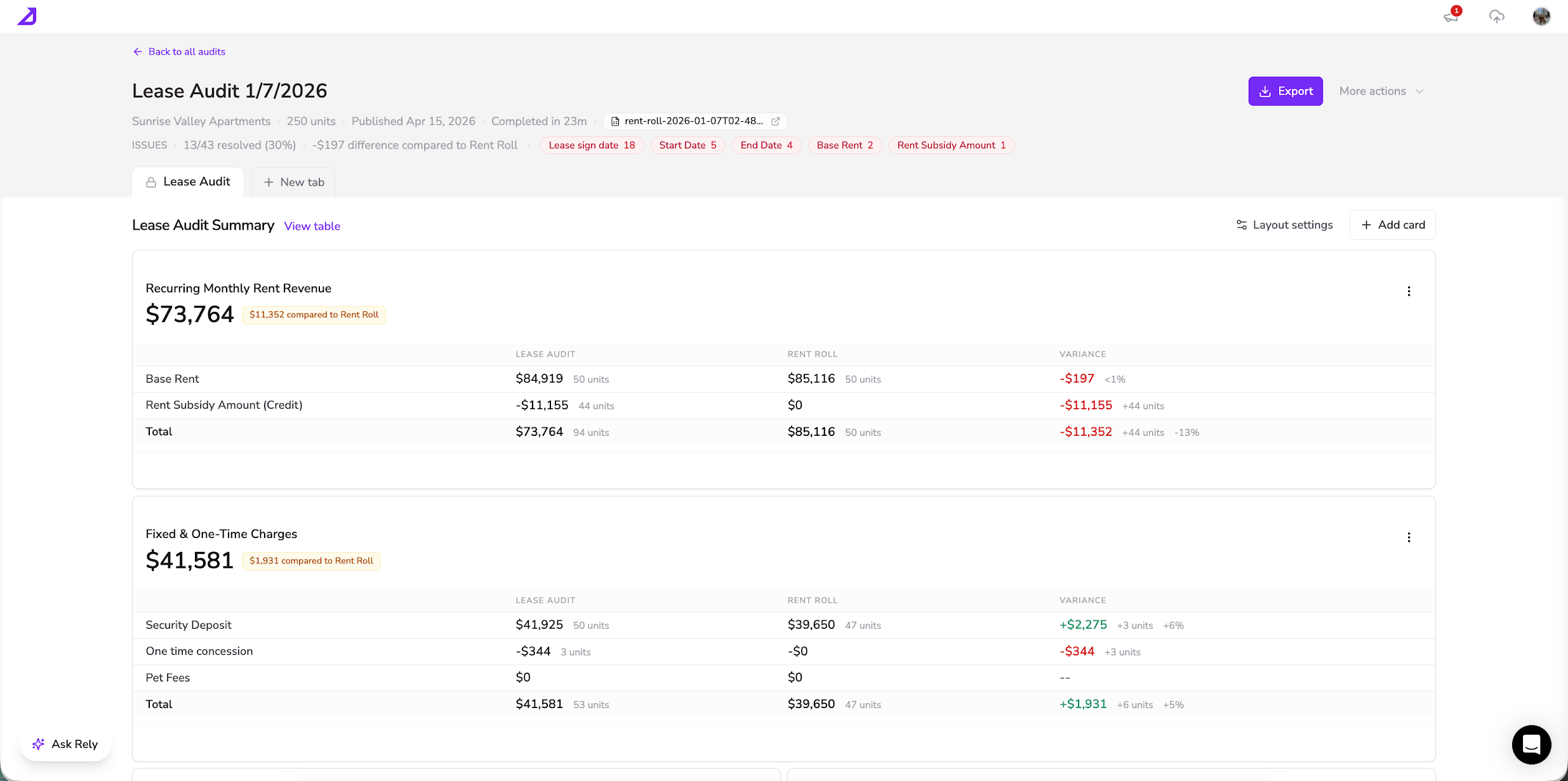
Every multifamily property contains thousands of pieces of information describing how it operates. Lease terms define revenue. Rent rolls summarize occupancy. Utility contracts establish operating expenses. Vendor agreements govern services, while financial statements attempt to capture the property's overall performance. In theory, these documents should reinforce one another. In practice, they often don't.
The problem is not that the information is unavailable. It is that it lives across dozens of disconnected documents created by different people, at different times, for different purposes. Every acquisition, transition, refinance, or audit requires teams to manually reconcile those records before they can confidently move forward. The work is less about finding data than determining which version of the truth is correct.
That challenge has grown more difficult as transaction timelines continue to compress. Investment teams are expected to review more information in less time while maintaining the same level of accuracy. Faced with thousands of pages and hard deadlines, even experienced professionals are forced to prioritize speed over completeness. Corners are not cut because teams lack expertise. They are cut because there simply are not enough hours in the day.
The Limits of Manual Review
Historically, multifamily audits have depended on people. Internal teams review leases line by line, consultants validate rent rolls, temporary staff handle large portfolios, and offshore review teams provide additional capacity during busy transaction periods. While these approaches can produce accurate work, they scale only by adding more labor.
The process introduces another challenge: consistency. Two analysts reviewing the same lease may interpret language differently. Manual data entry introduces errors. Findings become disconnected from their original source documents, making it difficult for managers and investment committees to verify conclusions. The larger the portfolio, the greater the operational burden becomes.
Artificial intelligence changes that equation. Rather than asking people to read every page repeatedly, AI can now classify documents, extract information, compare records across sources, and identify discrepancies at a scale that was previously impossible. The opportunity is no longer simply to review documents faster. It is to create a repeatable system for establishing what is true about a property.
The Rely Story

George Matelich and David LoBosco founded Rely in early 2025 after recognizing that one of multifamily's most labor-intensive workflows had remained largely untouched by modern software. George brought experience spanning software engineering, product leadership, and multifamily technology through his work at Updater. David, Rely's co-founder and CTO, previously led product and engineering at Upright Labs, building enterprise software designed to operate at scale.
Rather than building another workflow tool, the founders focused on a more fundamental question. How do you help multifamily teams trust the information they use to make decisions? The answer was not another spreadsheet or another dashboard. It was a platform capable of turning thousands of unstructured property documents into structured, verifiable data, with every conclusion linked directly back to its source.
That philosophy shaped Rely from the beginning. Every extracted lease term, every discrepancy, every financial comparison, and every audit finding remains connected to the original document. Instead of asking users to trust the software, Rely asks the software to prove itself.
From Documents to Decisions
Customers begin by uploading leases, rent rolls, contracts, financial statements, compliance records, utility bills, and other property documents into the platform. Rely classifies each document automatically, extracts key information, compares it across multiple sources, and flags inconsistencies that require attention. Every finding is supported by citations back to the original file, allowing users to verify conclusions without repeating the entire review process.
The workflow extends well beyond acquisitions. Customers use Rely during ownership transitions, operational audits, lender reviews, lease compliance projects, and other high-volume processes where accuracy and speed are equally important. What once required multiple teams working through spreadsheets becomes a centralized review process supported by AI.
The impact is significant. Customers routinely reduce manual audit time by more than 90 percent while increasing the consistency of their findings. Rather than hiring temporary staff or expanding review teams, organizations can process larger portfolios using the people they already have.
When Time Matters Most
The value of automation becomes most visible when deadlines leave no room for error.
One customer received critical property documentation after five o'clock on a Monday evening with a hard-money deadline scheduled for nine o'clock the following morning. Under a traditional review process, completing the audit overnight would have been nearly impossible. Using Rely, the team finished the review with time to spare, allowing the transaction to move forward without sacrificing diligence.
Another customer, Olympus Property, previously spent days—and in some cases weeks—conducting lease audits manually. After implementing Rely, the organization dramatically reduced turnaround times while improving the consistency and traceability of every finding. Instead of accelerating existing workflows through additional labor, the company fundamentally changed how those workflows were performed.
These examples highlight an important shift. Artificial intelligence is not simply making auditors faster. It is allowing organizations to operate at a scale that manual review could never realistically support.
Building a System of Trust
As artificial intelligence becomes more deeply embedded within real estate, the industry's next challenge may not be automation itself. It may be trust.
Property information will continue to live across fragmented software systems, spreadsheets, scanned documents, and third-party vendors. New applications will emerge, but fragmentation is unlikely to disappear. If anything, it may become more pronounced as organizations adopt specialized AI tools for individual workflows.
Rely's long-term vision is to become the system that reconciles those fragmented sources into a trusted foundation for decision-making. Rather than producing answers alone, the platform seeks to produce answers that are transparent, defensible, and fully traceable back to their origin. In a world where AI increasingly performs analytical work, explainability becomes just as important as speed.
The Future of Multifamily Operations
The next generation of multifamily software will likely be defined less by individual applications and more by confidence in the data connecting them. Owners, operators, lenders, and service providers all rely on the same property information, yet they frequently maintain different versions of the truth. Reconciling those differences has traditionally required significant human effort.
Companies like Rely are betting that artificial intelligence can fundamentally change that equation. The greatest opportunity may not lie in replacing people. It may lie in eliminating the repetitive work that prevents people from applying their expertise where it matters most.
For years, multifamily technology has focused on helping professionals manage properties more efficiently. The next wave may focus on something even more foundational: helping them trust the information those decisions depend on. Because in an industry built on data, confidence begins long before a decision is made. It begins with knowing the data itself is right.
Learn more about Rely at https://www.tryrely.ai/