Case Study: CenterCheck

The Missing Metric in Retail Real Estate
Retail real estate has never suffered from a shortage of data. Brokers analyze demographics, investors evaluate cap rates, landlords monitor occupancy, and retailers increasingly rely on mobile location intelligence to understand where consumers go. Over the past decade, an entire ecosystem of software has emerged to measure visits, estimate trade areas, and forecast demand. The modern shopping center is surrounded by data, yet one of the industry's most important metrics remains remarkably difficult to obtain.
The challenge is that movement is not the same as commerce. Knowing that someone walked into a shopping center does not reveal whether they made a purchase, how much they spent, or whether neighboring retailers benefited from that visit. Commercial real estate has become increasingly sophisticated at measuring activity around an asset. It has remained far less capable of measuring the economic performance occurring inside it.
The following case study explores the future of retail intelligence through the lens of one company attempting to close that gap. CenterCheck is building a platform that leverages anonymized credit and debit card transaction data to estimate tenant sales, measure consumer spending patterns, and understand how retailers influence one another within a shopping center. More broadly, however, CenterCheck represents a shift in how retail real estate may evaluate performance, moving beyond proxies such as foot traffic toward direct measures of economic activity.
Beyond Foot Traffic
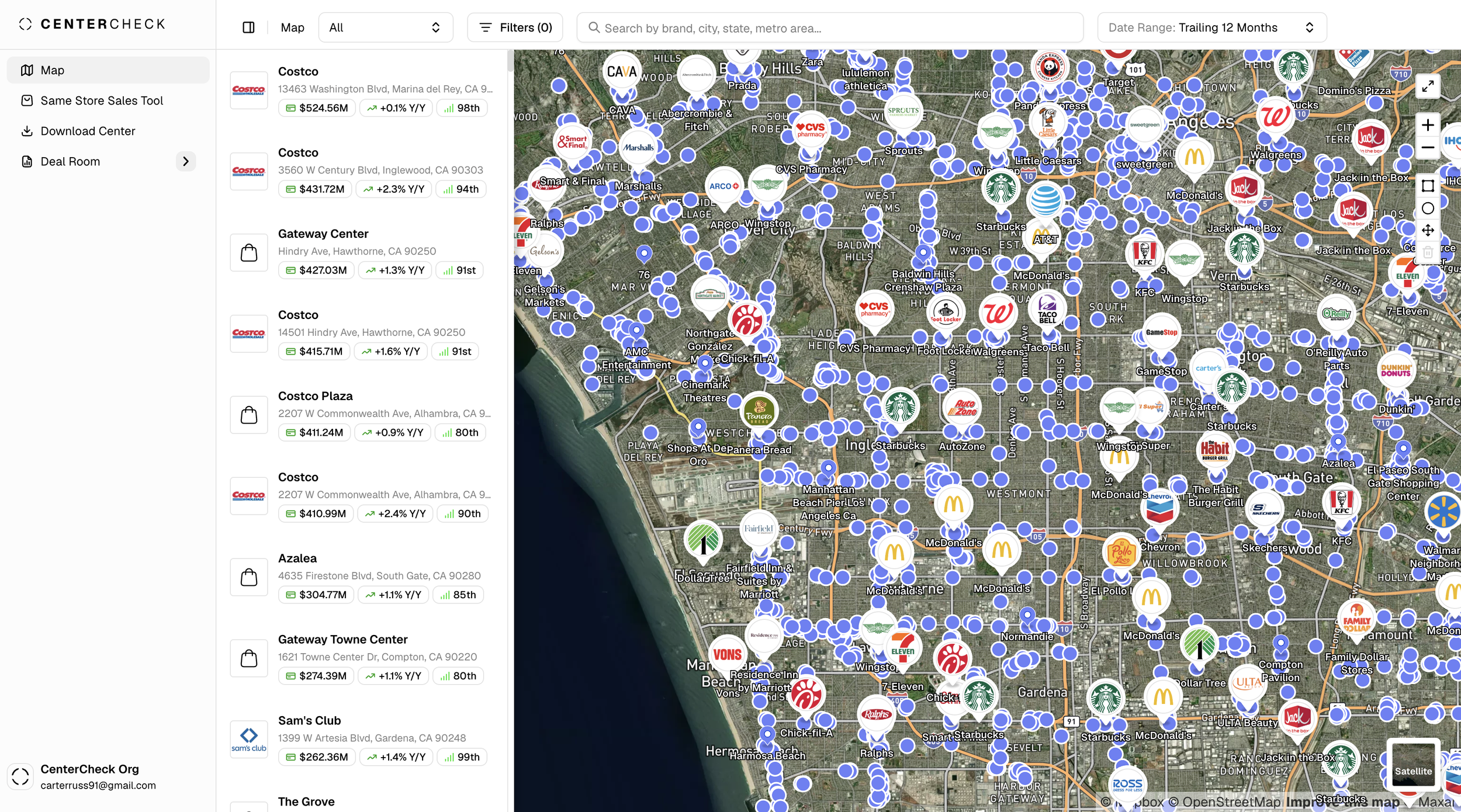
Retail has always been an information business disguised as a real estate business. Every leasing decision is ultimately an investment in future consumer behavior. Landlords and retailers have long relied on foot traffic, demographics, and vehicle counts because they were among the only signals available. Those metrics helped explain where consumers went, but they could only infer what happened once they arrived.
That distinction has become increasingly important as operating margins tighten and expansion decisions carry greater financial consequences. Two shopping centers can generate similar levels of foot traffic while producing dramatically different tenant sales. A retailer with relatively few visitors may outperform a neighboring store because customers spend more per visit or return more frequently. Opening the wrong location is no longer simply an opportunity cost. Once inventory write-downs, lease termination costs, and liquidation expenses are considered, a failed store can cost millions of dollars.
The result is a growing demand for something the industry has historically lacked: a direct measure of commercial performance. Understanding where consumers go remains valuable, but understanding what they spend, how often they return, and how their purchasing behavior influences neighboring retailers provides a far more complete picture of an asset's economic health.
The CenterCheck Story

CenterCheck was founded by Carter Russ, whose perspective on the industry began long before he entered technology. As a tenant representative, Russ spent years helping national retailers identify new locations, only to discover that many of the industry's most important decisions relied on qualitative observations rather than measurable performance. Parking lots were busy, coffee shops appeared full, and local brokers shared anecdotal knowledge about trade areas, yet one question consistently determined whether a retailer had confidence in a site.
"The number one question I kept hearing was, 'Do you know the sales of that store?'" Russ recalls. "Really, all I had working for me was, 'When you take your kids to school, you drive past this intersection, the parking lot is always full, and I asked the store manager how business was doing.' That wasn't enough when retailers were making million-dollar location decisions."
That experience became the foundation for CenterCheck. Rather than relying on indirect signals to estimate retail performance, the company partnered with major payment networks and financial institutions to analyze anonymized credit and debit card transactions across retail locations. The result is a platform that helps landlords, retailers, lenders, brokers, and investors understand not simply where consumers go, but how economic activity flows throughout a shopping center.
When Sales Become Intelligence
Sales data by itself is valuable. Context transforms it into intelligence.
CenterCheck analyzes estimated tenant sales alongside customer overlap, geographic trade areas, shopping frequency, visit timing, and demographic characteristics. The goal is not simply to identify a high-performing retailer, but to understand why that retailer performs well and how it influences the broader ecosystem within a shopping center.
One feature illustrates this shift particularly well. Rather than evaluating tenants independently, the platform measures how frequently customers spend across multiple retailers within the same center. A retailer generating modest revenue may nonetheless function as an important traffic generator, encouraging customers to visit neighboring businesses. Another tenant may produce strong sales while contributing relatively little to the surrounding merchandising mix.
These relationships have historically been difficult to quantify. Leasing teams often relied on experience and intuition to understand tenant synergies. CenterCheck attempts to measure those relationships directly, allowing owners to evaluate not simply who generates revenue, but who generates value for the broader property.
When Conventional Wisdom Breaks Down
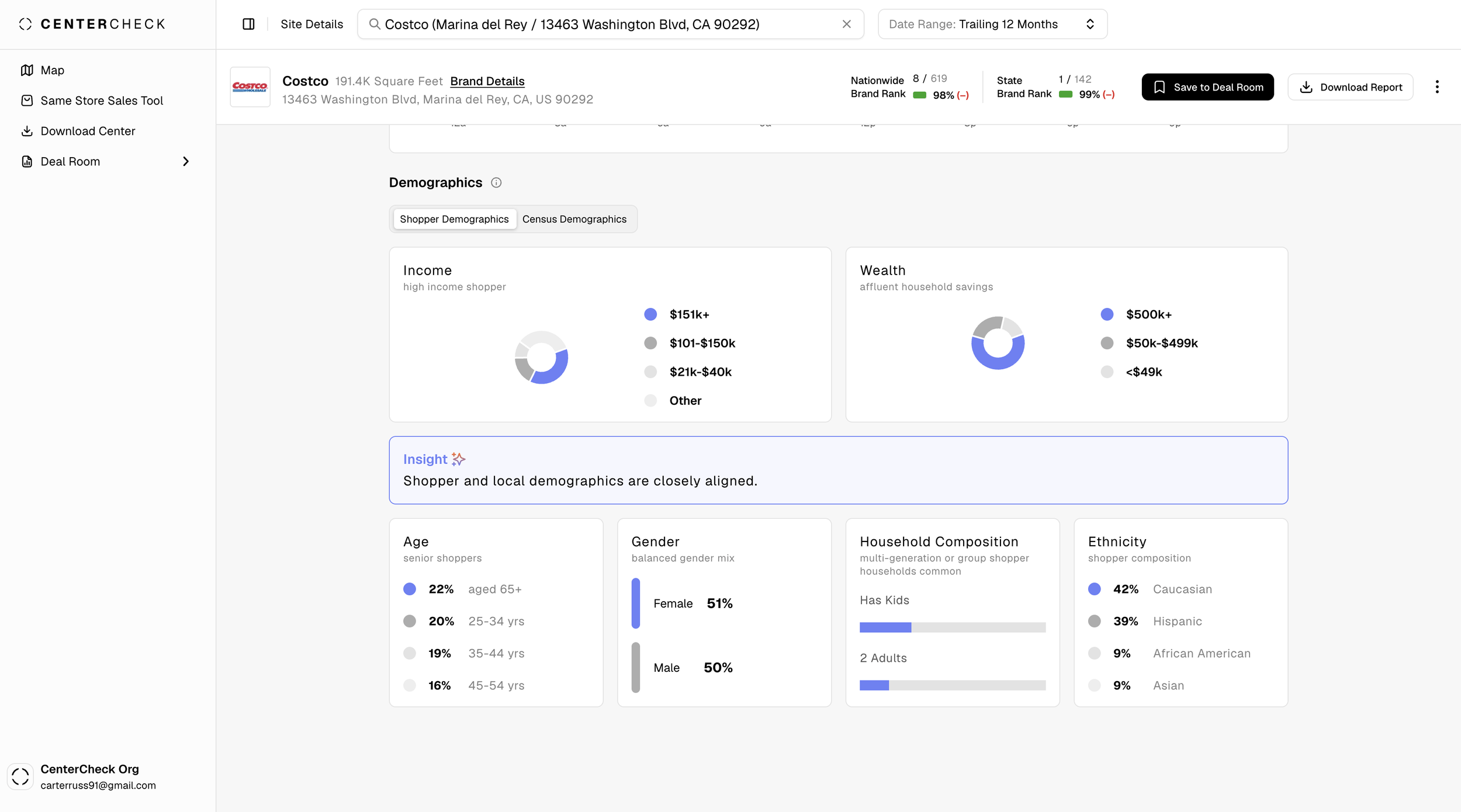
One of the more interesting implications of CenterCheck's approach is how frequently it challenges conventional assumptions built from traditional location intelligence.
Russ described one example involving a Family Dollar store in Ely, Nevada. Conventional visitation data suggested the location ranked among the weakest performers in the chain because the surrounding community generated relatively little traffic. Yet transaction data told a different story. While few people visited the store, local residents relied on it repeatedly throughout the month, making it one of the strongest revenue-producing locations within the portfolio.
The distinction highlights an important limitation of proxy metrics. High visitation does not necessarily produce high sales, just as low visitation does not necessarily indicate poor performance. Consumer behavior depends on frequency, basket size, local competition, and shopping habits that cannot always be inferred from movement alone.
For investment professionals, these differences influence underwriting. For retailers, they shape expansion strategies. For landlords, they affect merchandising decisions that can alter long-term asset performance.
A New Layer of Retail Intelligence
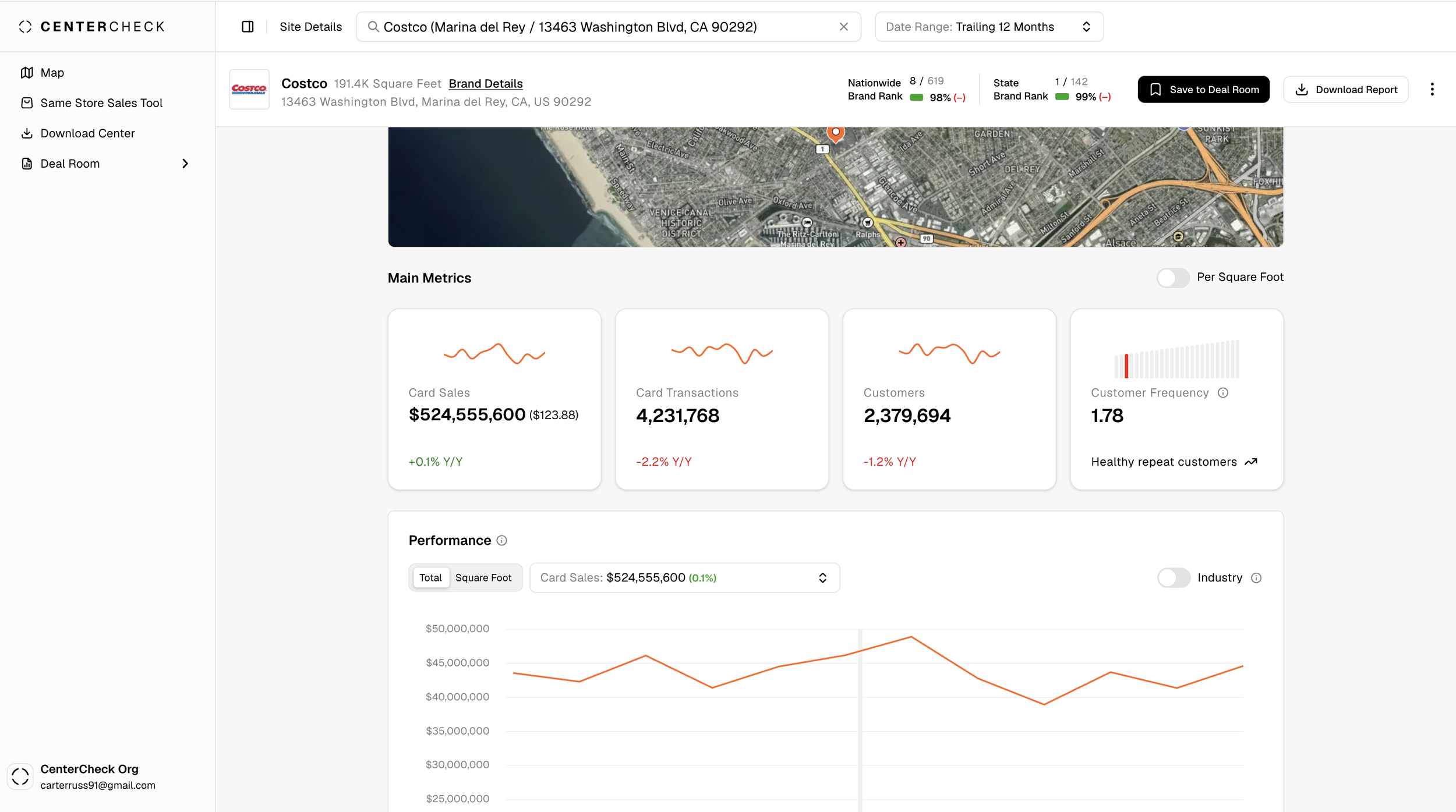
Commercial real estate has always relied on multiple sources of information to reduce uncertainty. Demographics explain who lives nearby. Traffic counts explain how people move. Mobile location data explains where consumers visit. CenterCheck introduces another layer by attempting to explain how money moves throughout the retail ecosystem.
That additional layer becomes increasingly valuable as stakeholders seek greater precision in their decisions. Retailers evaluating expansion opportunities can compare existing tenant performance rather than relying solely on trade area characteristics. Lenders gain another perspective on tenant health when underwriting retail assets. Owners can better understand which retailers strengthen the performance of an entire shopping center rather than simply maximizing individual rent.
The opportunity extends beyond individual transactions. As more centers, retailers, and markets become measurable, benchmarking across portfolios becomes increasingly possible. Shopping centers that once appeared similar on paper may reveal fundamentally different patterns of consumer spending and tenant interaction.
The Future of Retail Decisions
For years, retail technology has focused on understanding where consumers go. The next generation of intelligence platforms appears increasingly focused on understanding what consumers actually do once they arrive.
That evolution reflects a broader shift taking place across commercial real estate. Decisions are becoming less dependent on proxies and increasingly grounded in measurable outcomes. AI, alternative data, and large-scale transaction intelligence are allowing owners and investors to observe markets in ways that were previously impossible.
Companies like CenterCheck are contributing to that transformation by expanding the industry's understanding of economic performance itself. The most valuable retail intelligence platform may not be the one that counts the greatest number of visitors. It may be the one that best explains the commercial relationships occurring beneath those visits.
Because in retail real estate, traffic has always mattered. Commerce is what ultimately determines value.
Learn more about CenterCheck at centercheck.com