
Key Takeaways
Proptech companies raised approximately $1.65 billion across 34 funding rounds in October 2026, with more than half of all capital going to Construction & Development.
Construction & Development attracted approximately $872.4 million, or 52.8% of total capital, while Residential accounted for another $604.4 million, or 36.6%. Collectively, the two categories represented nearly 90% of October funding.
Approximately $588.6 million, or 35.7% of total capital, came from debt rounds, reflecting the growing importance of structured capital in housing finance, development lending, and construction.
1. Capital & Market Activity
CRETI tracked $1.651 billion across 34 disclosed proptech funding events in October, making it one of the strongest months of 2026. Bedrock Robotics led the month with a $600 million Series C, followed by Unlock’s $433.1 million debt financing, ICON’s $200 million Series D, and CrowdProperty’s approximately $133.5 million debt round.
Bedrock Robotics, Unlock, and ICON alone accounted for approximately $1.23 billion, or 74.7% of all October capital, while the five largest transactions represented roughly 87% of the month’s funding.
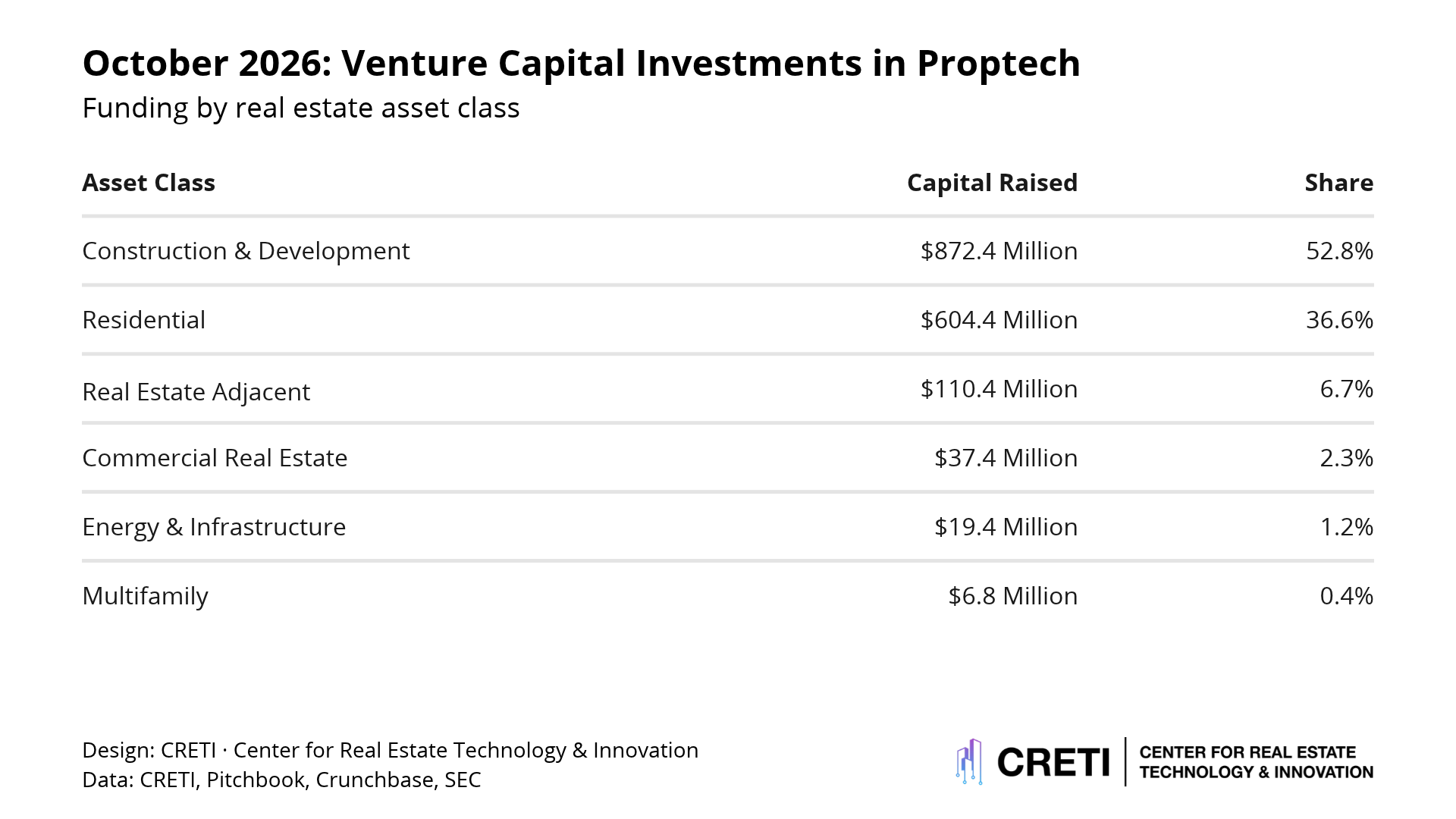
Construction Captured More Than Half of October Capital
Construction & Development attracted approximately $872.4 million across 12 companies, making it the clear center of proptech investment in October.
Bedrock Robotics’ $600 million Series C accounted for the majority of category funding. ICON added a $200 million Series D, while Origin raised $20 million, Dream raised $17 million, Riverchain secured $10 million in debt, and additional capital went to Aatmunn, Pathways Technologies, reebuild, Punch, Constrik, Concretene, and Nuckle AI.
The breadth of these companies is as important as the headline funding. Capital moved into construction robotics, 3D construction, procurement, worker safety, architectural design, working capital, building materials, bidding, and project workflows.
The investment case remains tied closely to real estate economics. Technologies that reduce labor requirements, shorten schedules, improve procurement, lower material costs, or improve project execution can directly affect development basis, margins, carrying costs, and development yield.
Residential Funding Was Driven by Finance & Lending.
Residential attracted approximately $604.4 million, representing 36.6% of October funding.
Unlock accounted for $433.1 million through debt financing supporting its home-equity agreement platform, while CrowdProperty raised approximately $133.5 million in debt for residential development lending. Zippy raised $20 million, Rently secured $12 million in debt, Homa raised $5 million, and smaller financings went to residential marketplaces, home services, and renovation technology.
Much of October’s Residential funding was not simply equity invested in software companies; it was capital used to support financial products tied to housing transactions, home equity, development lending, and property finance.
Adjacent Industries Are Becoming More Important to Proptech
Approximately $110.4 million flowed into companies CRETI classifies as adjacent or cross-asset, including property insurance, financial infrastructure, and related services. Stand’s $70 million Series C was the largest transaction in the group, while Coast raised $35 million and smaller rounds went to Fruga, Delegance Brokerage, Atlian Insurance, and Aqar Exit.
Commercial Real Estate attracted approximately $37.4 million, including Mogul, Carbon, MARC, Vessla, and Cortas. Energy & Infrastructure attracted approximately $19.4 million, led by VECKTA and Bageera, while Multifamily accounted for $6.8 million through DrizzleX.
The relatively smaller totals should not imply these categories are strategically unimportant. Insurance, energy, lending, and financial services increasingly determine operating expenses, risk exposure, asset value, and access to capital, making the boundaries of what qualifies as real estate technology increasingly fluid.
CRETI’s Perspective
October’s $1.65 billion funding total was significant. Construction & Development and Residential accounted for approximately 89.4% of all capital, with much of the month’s funding tied directly to creating, financing, or improving the physical asset.
Approximately $588.6 million came through debt, representing more than one-third of October capital. Unlock, CrowdProperty, Rently, and Riverchain demonstrate how debt and structured finance are becoming an increasingly important part of the proptech capital market rather than an edge case.
For investors, the market appears increasingly concentrated around companies addressing large economic problems: construction productivity, housing liquidity, development finance, materials, insurance, and operating infrastructure. For founders, that raises the bar for demonstrating not only product differentiation, but a credible connection between the technology and a material financial outcome.
For real estate executives, funding remains a useful signal of investor conviction and a company’s potential staying power, but it is not evidence of portfolio-level ROI. The more important question is whether the technology can materially improve development yield, operating expenses, revenue, labor productivity, risk, or capital efficiency.