
The commercial real estate labor market is hiring across the asset lifecycle, from property operations and leasing to capital markets, asset management, development, engineering, and professional services.
CRETI identified 3,339 U.S. commercial real estate-related job openings in October 2026.
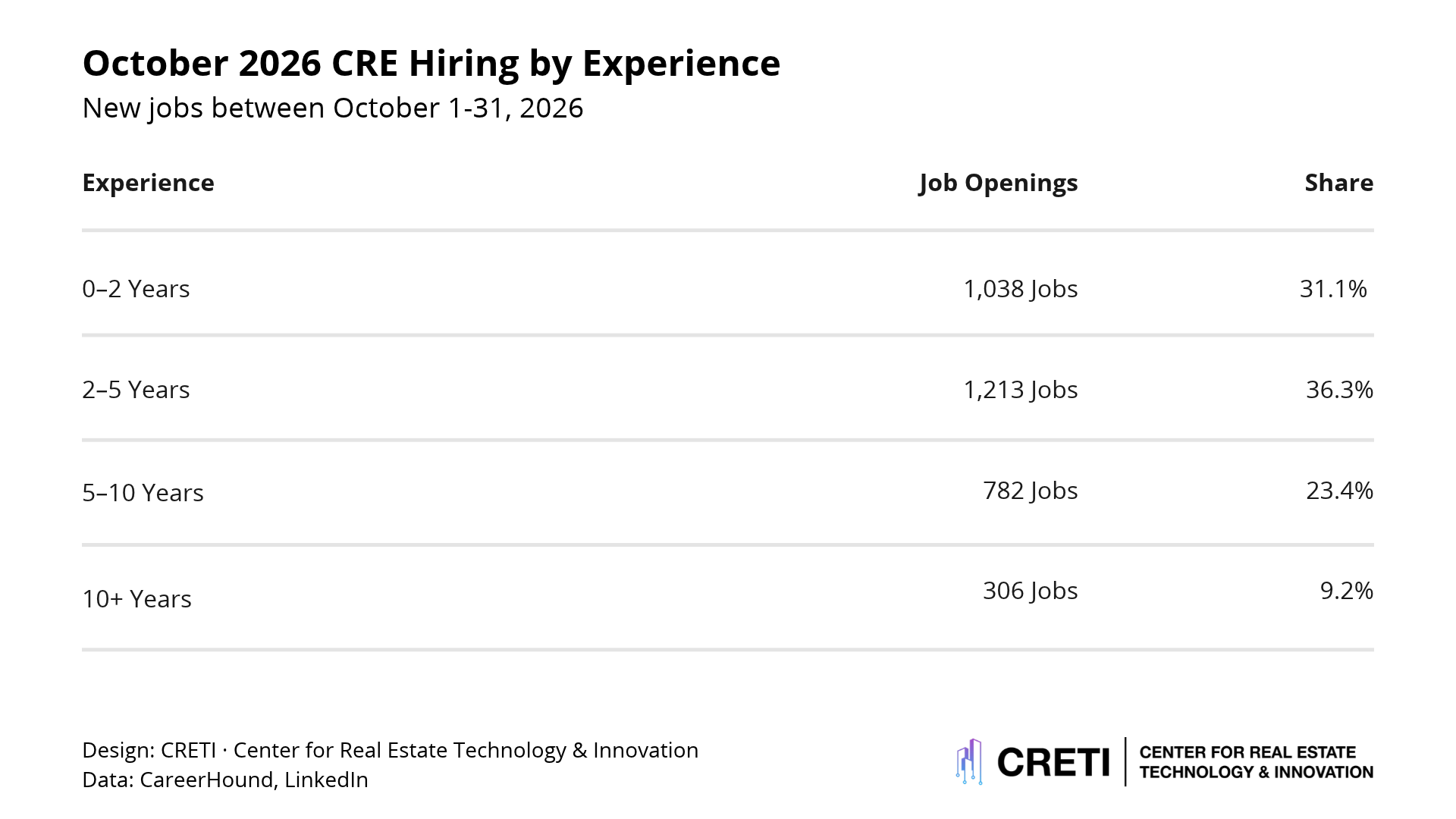
The largest concentration was among professionals with two to five years of experience, with 1,213 openings accounting for about 36.3% of the market. Another 1,038 positions targeted professionals with zero to two years of experience.
Combined, approximately 67% of October CRE openings targeted candidates with fewer than five years of experience.
But the composition of those jobs changes considerably as experience increases.
Early-career openings concentrate on property administration, leasing, credit, accounting, analyst, facilities, and support functions. The five-to-ten-year market begins to shift toward asset management, property management, development, lending, appraisal, engineering, and project leadership. At 10+ years, the market becomes significantly more specialized around senior asset management, capital markets, construction, legal, engineering, risk, and executive real estate leadership.
Entry-Level CRE Is Much Broader Than Brokerage
The 0–2 year cohort represented 1,038 openings, or 31.1% of October demand.
Large, recognizable organizations in this experience band include CBRE, CoStar, JLL, Lincoln Property Company, Cushman & Wakefield, Colliers, JPMorgan Chase, RBC, PNC, and Huntington National Bank.
Early-career professionals are entering commercial real estate through data, banking, credit, property administration, leasing, accounting, research, and operations.
Unlike residential and multifamily, the commercial real estate labor market is creating multiple pathways into real estate expertise, not just brokerage and property management.
A junior analyst entering CRE through lending may eventually move into acquisitions or asset management. A property administrator may progress into property management. A leasing coordinator can develop into an agency or landlord-representation role. A market-intelligence analyst may move toward investment strategy or brokerage research.
Commercial real estate's talent pipeline is increasingly multidisciplinary.
The Labor Market Becomes More Specialized After Five Years
The most interesting shift occurs after approximately five years of experience.
Of October's openings, 782 positions, or 23.4%, required five to ten years of experience.
At this level, the job titles begin moving noticeably away from administrative and support functions and toward roles with responsibility for assets, capital, projects or specialized technical disciplines.
Employers visible in this cohort include Wawa, RMR Group, Lincoln Property Company, JLL, Cushman & Wakefield, U.S. Bank, KeyBank, and others.
The transition is economically important.
At the beginning of a CRE career, employees tend to support transactions, properties, customers, or analytical processes.
By the five-to-ten-year stage, they increasingly own outcomes.
They may be responsible for a property, a portfolio, a development project, a lending process, a facilities operation, a lease strategy or an investment decision.
Experience therefore appears to change not simply compensation, but the type of risk the employee is trusted to manage.
Senior CRE Hiring Is Concentrated Around Capital, Risk and Complex Assets
The 10+ year cohort represented 306 positions, or 9.2% of October CRE openings.
Employers represented include JLL, Newmark, Cushman & Wakefield, RMR Group, Regions Bank, U.S. Bank, Jamestown, Walker & Dunlop, and other major institutions and service providers.
This shows where experience matters most in CRE.
The senior labor market is disproportionately connected to capital allocation, asset performance, lending risk, development execution, complex transactions, legal exposure, and portfolio-level decision-making.
These roles are expensive when errors occur.
An underwriting decision can affect millions of dollars of capital. A development decision can influence basis and yield. A poorly negotiated lease can affect asset value. Engineering or construction mistakes can create significant capex exposure. Asset-management decisions directly influence NOI and exit value.
Senior CRE employment therefore becomes increasingly tied to managing financial and physical risk.
CRE Hiring Extends Far Beyond Property Companies
One of the most important characteristics of the October data is the diversity of employers, and companies whose core businesses are not real estate but whose operations require substantial real estate capabilities.
Examples in the October listings include Wawa and Smoothie King, both recruiting real estate professionals for site selection, expansion, and portfolio strategy.
The CRE labor ecosystem also includes the organizations that finance real estate, occupy it, build it, insure it, value it, manage it, transact it and advise on it.
That makes the industry's economic footprint much broader than traditional landlord, developer, or brokerage employment.
CRE Has a More Experienced Hiring Profile Than Multifamily
October's CRE data also differs meaningfully from the residential and multifamily labor market.
In CRE, approximately 32.6% of openings required five or more years of experience.
In the multifamily data CRETI analyzed for October, that figure was approximately 20.7%.
The 10+ year category represented 9.2% of CRE openings, compared with approximately 5.5% in multifamily.
Commercial real estate's hiring market contains a larger concentration of roles tied to capital markets, lending, asset management, valuation, legal, development, engineering, and corporate real estate strategy.
These functions often require deeper domain experience before an employee can take on meaningful responsibility independently.
Multifamily's labor market, by comparison, is more heavily concentrated around property-level and portfolio operations.
The two sectors face different workforce challenges.
CRETI’s Perspective
October's 3,339 commercial real estate openings show an industry whose labor needs span virtually every stage of the asset lifecycle.
Early in the career path, companies hire property administrators, analysts, leasing professionals, credit employees, and assistant property managers.
A few years later, demand expands into property management, underwriting, investment analysis, accounting, facilities management and engineering.
At higher experience levels, the market increasingly rewards professionals who can manage assets, capital, construction, credit, transactions, and risk.
That progression matters for how CRE executives should think about technology.
AI is unlikely to affect every part of this labor market equally.
The greatest near-term opportunity will likely occur where employees spend significant time collecting and analyzing information, processing documents, reconciling data, preparing analysis, administering workflows, and identifying exceptions.
The strategic value of technology will likely be measured by whether it lets experienced professionals spend more time on judgment.
Methodology
CRETI's October 2026 analysis is based on 3,339 U.S. job openings returned through CareerHound searches using the keyword “Commercial Real Estate,” jobs posted within the previous month, U.S. location filters and experience-level segmentation.
The experience cohorts were:
0–2 years: 1,038 openings
2–5 years: 1,213 openings
5–10 years: 782 openings
10+ years: 306 openings
One important methodological distinction is that this should be understood as a CRE-related jobs dataset rather than a census of employees working exclusively for commercial real estate companies.
The results include traditional real estate companies, property-services firms, lenders, law firms, retailers, engineering companies, security providers and other organizations where commercial real estate appears as part of the job function or required expertise.
That breadth is useful because it captures the wider ecosystem surrounding commercial property, but it should be considered when interpreting the total job count.