Case Study: Tower

Commercial real estate has spent the better part of two decades improving how deals are analyzed. Underwriting platforms help investment teams evaluate opportunities faster. Data rooms make it easier to share information. AI-powered review tools can summarize leases, extract key terms, and answer questions that once required hours of manual work. The industry has become increasingly sophisticated at processing information once it has been collected.
The challenge is that diligence begins long before analysis. Before a lawyer reviews a lease or an analyst builds a model, someone has to determine what information is required, collect it from multiple stakeholders, confirm it is complete, and identify what may still be missing. Despite billions of dollars flowing through commercial real estate transactions every year, much of that process continues to run through spreadsheets, Word documents, email chains, and shared folders. The industry's review capabilities have advanced dramatically. The process of gathering trustworthy information has not.
Today's case study explores the future of diligence management through one company bringing a new approach to market: Tower, a platform designed to manage the diligence lifecycle from information collection through document review and post-close knowledge management. But Tower also represents something larger. As AI becomes increasingly embedded within transaction workflows, the next generation of diligence technology may be less focused on reviewing documents and more focused on ensuring the right information was collected before review ever begins.
The Information Problem
When diligence failures occur, the assumption is often that somebody missed something during review. A lease provision was overlooked. A contract obligation was misunderstood. A financial assumption was modeled incorrectly. The reality is often more mundane. The problem is not that teams reviewed poorly. The problem is that they didn’t review the right information in the first place.
This challenge has become more pronounced as transactions have grown more complex. Modern acquisitions can involve thousands of pages of leases, amendments, service agreements, insurance certificates, permits, financial statements, and organizational documents. Many of those records arrive in different formats, from different stakeholders, at different points in the process. Determining whether information exists is often easier than determining whether the information set is complete.
The consequences extend well beyond diligence itself. Missing amendments can alter lease economics. Incomplete contracts can obscure liabilities. Expired insurance documents can create risk that surfaces months after a transaction closes. Diligence remains a garbage-in, garbage-out exercise. Every analysis, recommendation, and investment decision ultimately depends on the quality of information entering the process.
The Tower Story
Tower was co-founded by Noah Walters, a former M&A attorney and co-lead of the AI Industry Team at Dentons. Before building the company, the team interviewed more than one hundred professionals across commercial real estate, legal services, and investment firms to understand where diligence actually breaks down. The answer challenged many of the assumptions surrounding transaction technology.

"We interviewed over 100 people across deal teams to find where diligence actually goes wrong," Noah explains. "The answer wasn't the modeling or analysis. Instead, most of the hours and most of the anxiety go to the step before any of that: confirming you have the right information to review in the first place."
The observation points to a gap that has largely escaped attention. Virtual data rooms help store information, but they do little to verify whether the correct information has been provided. Review platforms can analyze documents, but they generally assume the collection and organization process has already been completed. The work that sits between those two systems—the collection, verification, and organization of diligence information loop —has remained largely manual.
Tower was built to address that gap.
Beyond the Data Room
The diligence request list sits at the center of nearly every transaction. It defines what information is required, establishes accountability among stakeholders, and serves as the framework through which diligence is conducted. Despite its importance, most request lists continue to live inside spreadsheets and Word documents that are versioned repeatedly throughout a transaction.
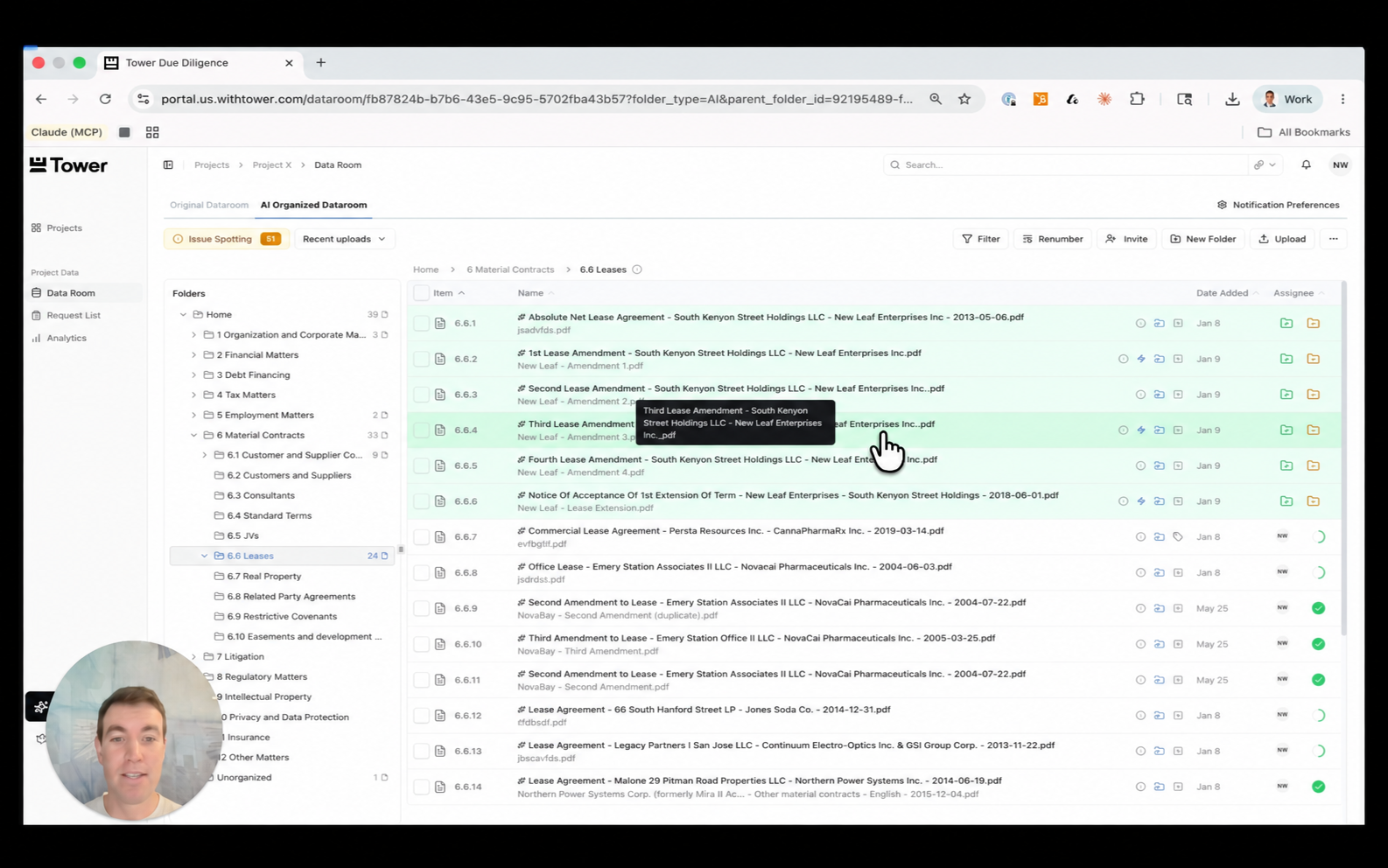
The process is familiar to anyone who has worked on a deal. Multiple copies circulate simultaneously. Questions are updated manually. Stakeholders struggle to determine what remains outstanding and what has already been addressed. Information arrives through separate channels and must be reconciled by hand. What begins as an organizational challenge often becomes a risk management challenge.
Tower replaces this workflow with a centralized diligence workspace that connects requests, responses, documents, and review activities into a single environment. Rather than managing diligence through disconnected systems, participants collaborate within one shared source of truth. The result is not simply greater efficiency. It is greater visibility into the state of the transaction itself.
When Documents Start Talking to Each Other
One of the more interesting aspects of Tower's approach is how it treats documents. Commercial real estate transactions rarely arrive as neatly organized collections of files. Leases have amendments. Amendments reference exhibits. Contracts contain schedules stored elsewhere. Understanding the relationship between documents is often as important as understanding the documents themselves.
Historically, identifying those relationships has required manual effort. Teams spend hours searching for missing amendments, reconciling versions, and confirming that document sets are complete. The work is tedious, but it is essential. A missing document can materially change the conclusions reached during diligence.
Tower uses AI to organize incoming files against diligence checklists and identify connections between related documents. The system can highlight missing amendments, incomplete document sets, unsigned agreements, and expiring records as information enters the platform. Instead of discovering gaps during review, teams gain the ability to identify them earlier in the process.
That shift may prove more important than faster review. The future of diligence is not simply about extracting answers from documents. It is increasingly about determining whether the right documents exist at all.
The Rise of Diligence Agents
The next phase of the platform points toward a broader transformation occurring across enterprise software. For decades, software functioned primarily as a tool. Users initiated work, and systems responded. The responsibility for determining what work needed to happen remained with the human operator.
Agentic systems introduce a different model. Rather than waiting for instructions, software begins identifying opportunities to act on its own. Tower's roadmap includes agents capable of reviewing incoming documents, generating follow-up diligence questions, identifying potential risks, and continuously updating findings as new information becomes available throughout a transaction.
An abstract prepared on day one can evolve automatically as additional lease information is uploaded. Findings can be re-evaluated when new documents arrive. Questions can be generated before a team realizes information is missing. The software moves beyond answering questions and begins participating in the diligence process itself.
This mirrors a broader trend emerging across real estate technology. Increasingly, the objective is not simply to help professionals process information faster. The objective is to reduce the amount of routine work required to manage information in the first place.
The System of Record
Perhaps the most overlooked aspect of diligence is what happens after closing. Acquisition teams spend weeks or months collecting institutional knowledge about an asset. They identify risks, uncover unusual provisions, and build a deep understanding of the information supporting the transaction. Much of that knowledge becomes fragmented once ownership transitions to asset management and operations teams.
The result is a surprising amount of rediscovery. Questions that were answered during acquisition often need to be answered again months later. Documents are reviewed repeatedly. Context gets lost as information moves between teams and systems. Institutional knowledge, despite its value, rarely survives the transaction intact.
Tower keeps diligence workspaces active after closing, creating a persistent system of record for the deal. What begins as a diligence environment evolves into a long-term repository of transaction knowledge. As portfolios become increasingly data-intensive, preserving institutional memory may prove just as valuable as collecting information in the first place.
The Future of Transactions
For years, commercial real estate technology has focused on helping professionals analyze deals more effectively. Better models, better reports, better dashboards, and better review tools have all improved decision-making across the industry. The next opportunity may lie further upstream.
Watch Tower Demo →
Before analysis, there is information. Before information, there is collection. And before collection, there is the challenge of determining what information should exist in the first place. As transactions become increasingly complex, that challenge becomes more consequential.
Companies like Tower are betting that the future of diligence will be defined less by document review and more by information completeness. The most valuable system may not be the one that answers questions the fastest. It may be the one that ensures the right questions were asked before the review ever began.
The firms that solve this problem first are likely to discover that better diligence is not fundamentally a review problem. It is an information problem. And in commercial real estate, the most expensive risk is often not the one that gets discovered during diligence. It is the one that never made it into the data room at all.
Learn more about Tower at withtower.com