Case Study: Brixely

Commercial real estate has spent decades standardizing information. Financial statements follow familiar formats. Environmental reports are prepared by specialists. Surveys, title commitments, leases, zoning reports, operating statements, engineering assessments, and hundreds of other documents have become the common language of institutional transactions. Every acquisition begins with the expectation that this information exists somewhere inside a virtual data room waiting to be reviewed.
The challenge is that while the documents have become standardized, the decisions built on top of them have not. Every investment team follows a different diligence process. Every analyst asks different questions. Every acquisition committee weighs risk differently. The industry's information has become increasingly digital, but the judgment required to transform thousands of pages into an investment decision remains remarkably manual.
Today's case study explores the future of investment diligence through one company attempting to rethink that process. Brixely is building an AI companion designed specifically for commercial real estate acquisitions, helping investment teams organize information, surface risks, and generate institutional knowledge throughout the diligence process. More broadly, however, the company represents an emerging shift from AI that simply reviews documents toward AI that helps organizations make better investment decisions.
Mountains of Information
As the world’s largest asset class, commercial real estate sees nearly one trillion dollars in transaction volume each year. Yet behind every acquisition sits a diligence process that remains remarkably manual, fragmented, and exposed to execution risk. Buyers are still forced to underwrite mission-critical decisions across thousands of pages of leases, engineering reports, surveys, environmental studies, operating statements, legal documents, spreadsheets, email attachments, and virtual data rooms.
Every transaction is different. Office towers, industrial portfolios, medical office buildings, shopping centers, and multifamily communities all generate unique diligence requirements, forcing investment teams to reconstruct the review process from the beginning every time a new opportunity arrives. The result is not simply an enormous amount of work. It is an enormous amount of variability.
Speed only compounds the problem. Competitive bidding processes leave buyers with limited time to evaluate increasingly complex assets. Investment teams are forced to balance thoroughness against execution, often accepting uncertainty simply because slowing down may mean losing the deal altogether.
The Cost of What Gets Missed
The greatest risks in commercial real estate are rarely the obvious ones. They are often buried inside documents that few people expect to contain critical information. A survey may reference an easement that changes redevelopment potential. An engineering report may identify structural concerns requiring millions of dollars in future capital expenditures. A lease amendment filed years earlier may fundamentally alter projected cash flow.

Varinder Saini, Brixely's co-founder and CEO, shared one example that illustrates the challenge. During a customer engagement, an underground diesel storage tank remained hidden inside a survey document for weeks. It took three weeks of manual diligence and thousands of dollars in professional review before the issue was identified, fundamentally changing the underwriting assumptions supporting the acquisition.
Running the same data room through Brixely produced a different outcome. The platform surfaced the same issue within minutes.
The story illustrates a broader point. AI's greatest contribution to commercial real estate may not be answering questions faster. It may be identifying the questions investment teams never realized they needed to ask.
Building an AI Companion
Brixely approaches diligence as a system rather than a collection of individual tasks. Instead of treating documents as isolated files, the platform gathers data rooms, stakeholders, and diligence workflows into a centralized workspace where information can be organized, reviewed, and continuously analyzed throughout a transaction.
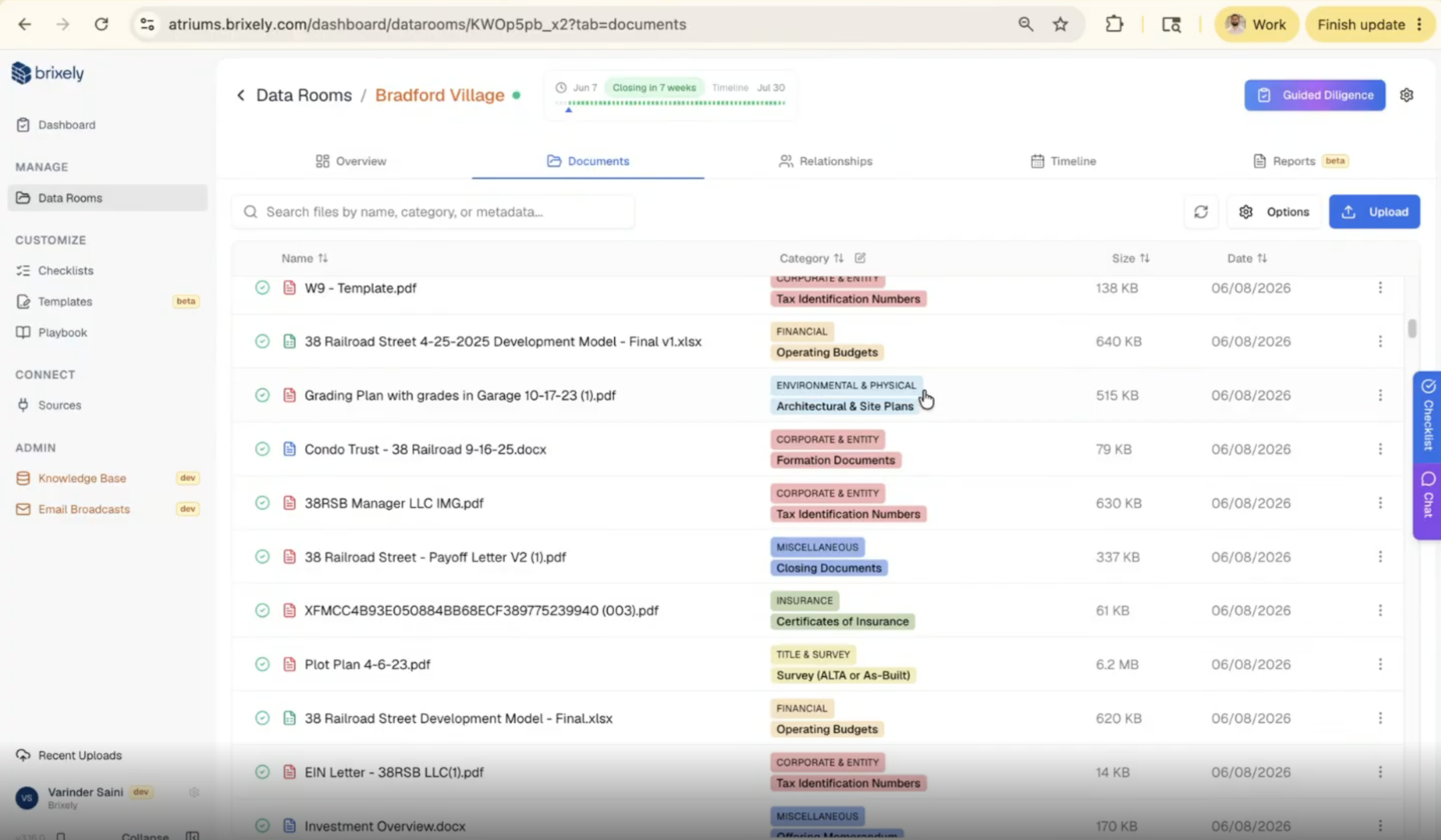
At the center of the platform sits an AI model trained specifically on commercial real estate documentation. Unlike general-purpose language models, the system is designed to recognize the structure and relationships that exist within property transactions. Surveys connect to environmental reports. Leases connect to amendments. Engineering assessments influence capital planning. Information that traditionally exists across hundreds of disconnected documents begins functioning as a connected body of knowledge.
The practical result is the automation of work that has historically consumed analysts' time. Documents are categorized automatically. Due diligence checklists are populated as information arrives. Supporting evidence remains connected to the conclusions generated throughout the review process. The goal is not simply to accelerate diligence. It is to reduce the operational burden that prevents investment professionals from focusing on higher-value judgment.
The process is familiar to anyone who has worked on a deal. Multiple copies circulate simultaneously. Questions are updated manually. Stakeholders struggle to determine what remains outstanding and what has already been addressed. Information arrives through separate channels and must be reconciled by hand. What begins as an organizational challenge often becomes a risk management challenge.
Intelligence at Scale
Every transaction processed by Brixely contributes to a growing body of institutional knowledge. The company has already evaluated more than $500 million in commercial real estate assets, processed over 300,000 pages of diligence documentation, and developed intelligence across more than 200 document types commonly found in transactions. Each additional deal strengthens the system's understanding of how information is structured and where risks most frequently emerge.
That accumulated knowledge creates opportunities extending beyond automation. As more transactions move through standardized workflows, entirely new benchmarks become possible. Investment teams may eventually compare diligence findings across asset classes, markets, and portfolios using data that has historically remained fragmented inside individual transactions. Standardization, long discussed within commercial real estate, becomes increasingly achievable when every deal contributes to a common intelligence layer.
The Next Operating System
Commercial real estate has never lacked information. Every acquisition already generates thousands of pages of documentation supported by highly specialized professionals. The industry's challenge has always been transforming that information into confident, repeatable decisions under extraordinary time pressure.
The next generation of acquisition technology appears increasingly focused on that objective. Software is evolving beyond document management and beyond document review toward systems capable of organizing institutional knowledge, identifying risk proactively, and supporting investment judgment throughout the life of a transaction.
Companies like Brixely are building toward that future. Whether the category ultimately becomes known as AI diligence, investment intelligence, or something entirely different matters less than the underlying shift taking place. Commercial real estate has spent decades digitizing documents. The next decade may be defined by digitizing the reasoning that turns those documents into investment decisions.
Learn more about Brixely at brixely.com