Case Study: PocketAM

The $4.5 Trillion Portfolio Nobody Manages
Institutional single-family rental has spent the past decade becoming a professionalized asset class. Large portfolios have dedicated teams managing financing, insurance, taxes, operating performance, capital allocation, and acquisitions. The individual rental owner may own the exact same type of asset, but the infrastructure surrounding that ownership looks entirely different.
Single-family rentals represent roughly $4.7 trillion in real estate, yet institutional investors holding 350 homes or more own only about 5 percent of the market. The remaining nearly $4.5 trillion is largely owned by individuals and small entities, many with fewer than ten homes. Those owners may have property managers, lenders, accountants, and insurance brokers, but they typically lack the one function institutions consider essential: someone responsible for managing the portfolio as a portfolio.
This case study explores that missing asset-management layer through one company attempting to bring institutional portfolio management to individual landlords. PocketAM is an AI asset manager and accountant built by the team behind SHARE, whose asset managers have overseen more than $7 billion in single-family and multifamily portfolios throughout their careers. More broadly, PocketAM represents an emerging application of AI in real estate: making professional capabilities that historically required institutional scale economically available to individual owners.
The Portfolio Nobody Is Watching
An asset manager has two fundamental responsibilities: improve the performance of the existing portfolio and identify opportunities to grow it. Doing either requires looking beyond individual properties to understand how equity, financing, insurance, taxes, rents, operating expenses, reserves, and market conditions interact across the entire portfolio.
Individual owners rarely have the capacity to continuously manage those variables. In SHARE's survey of nearly 3,000 users, seven in ten said they were investing to build wealth, while more than a third wanted to retire early or leave their current job. Yet across portfolios analyzed by SHARE, the average owner holds slightly more than 60 percent equity, meaning a substantial amount of capital may be sitting inside properties owned by investors who say they want to continue growing.
An institutional owner with significant unused equity would have an asset-management team evaluating whether that capital should be refinanced, redeployed, or otherwise optimized. A smaller landlord may simply continue making mortgage payments without realizing the portfolio has developed the capacity to fund another acquisition. The difference is not necessarily ambition; it is having someone whose job is to recognize the opportunity.
Everyone Holds a Piece
Small landlords are surrounded by professionals, but each participant typically sees only one part of the financial picture. A property manager runs the property, a lender understands the debt, an insurance broker manages coverage, and an accountant reconstructs financial performance after the year ends. Each relationship is necessary, but none is necessarily responsible for determining how those pieces should work together.
Software has developed along similar lines. Bank activity lives in one system, bookkeeping in another, operating information in a property-management portal, while loan documents, policies, leases, tax bills, closing statements, and invoices remain scattered across inboxes and folders. The owner technically possesses the information required to understand the portfolio, but rarely has a system capable of interpreting it as a whole.
That fragmentation limits the value of the underlying information. A mortgage balance becomes more meaningful when considered against current property value and interest rates. An insurance premium becomes actionable when compared with alternatives before renewal. Equity becomes useful when connected to the owner's acquisition strategy. Asset management begins when those individual facts become decisions.
The PocketAM Story

PocketAM was built by the team behind SHARE, but the problem began with co-founder Andrew Kim's own rental portfolio. Kim started acquiring properties in 2010 and experienced a problem familiar to many individual landlords: documents accumulated throughout the year, financial information remained fragmented, and tax season became an annual exercise in reconstructing what had happened.
"The truth is, as a family man and an entrepreneur, it's hard to carve out the time to grow and optimize your portfolio, and your property manager isn't responsible for that," Kim explains. "Fast-forward to 2020, and COVID was the next time I truly sat down to analyze my portfolio, only to realize I could have at least 4x'd it had I been focused on it."
That experience ultimately led to SHARE, which provides active asset management for rental-property owners. PocketAM takes the knowledge developed through that business and attempts to deliver it through software, allowing the asset-management function to reach landlords whose portfolios would never economically support a dedicated institutional team.
From Documents to Books
PocketAM begins with the documents landlords already produce. Statements, loan documents, tax bills, insurance policies, leases, invoices, and closing packages are sent into a centralized inbox, where the system classifies them and extracts relevant information. When confidence in an extraction falls below a defined threshold, the information moves into a review workflow rather than automatically becoming part of the owner's financial records.
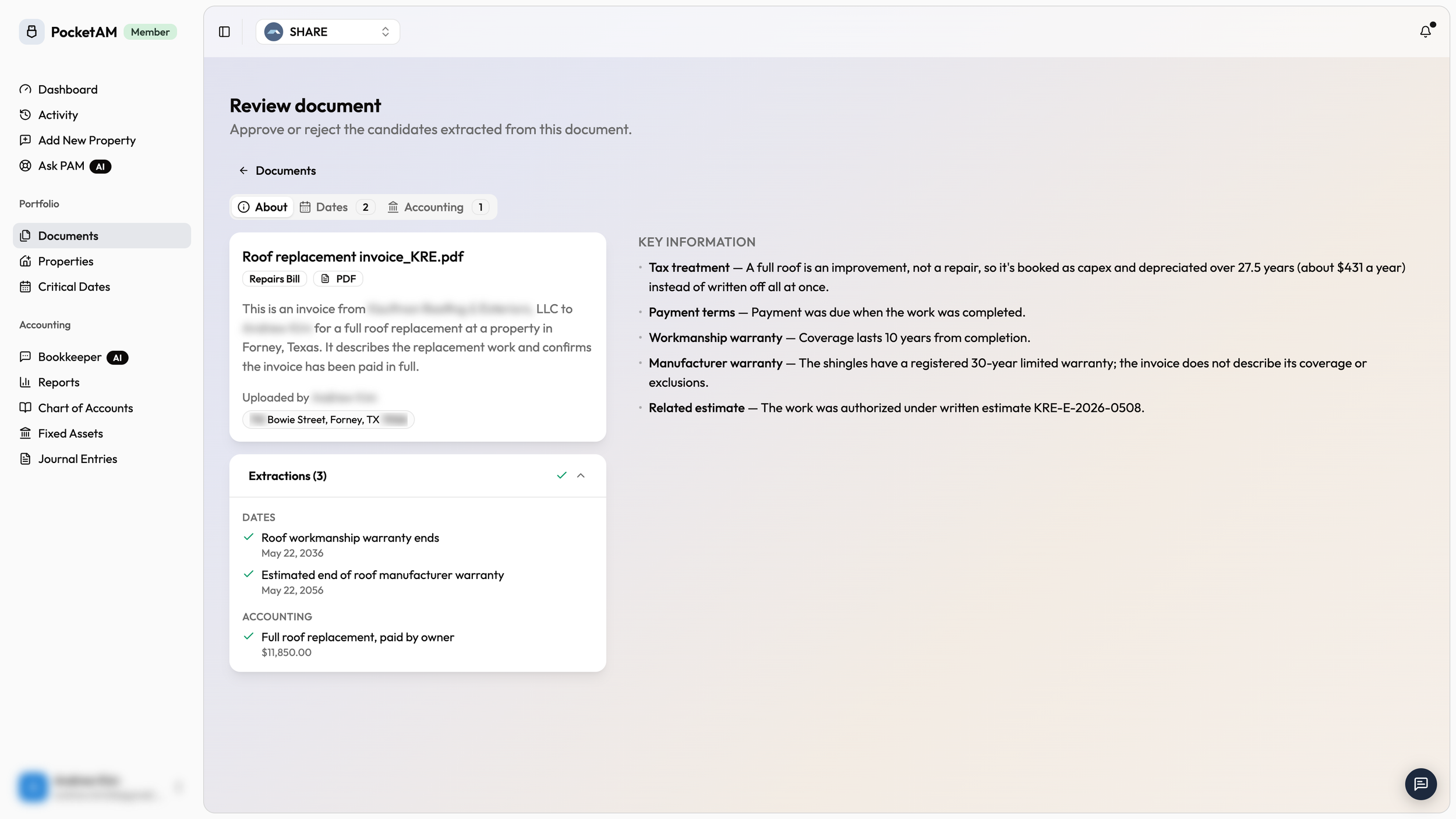
The same document can serve multiple purposes. A roof invoice contains an expense, but it may also contain an installation date and warranty period. A lease provides rent information alongside renewal dates, while a loan document establishes the principal balance, financing terms, and maturity. PocketAM attempts to read each document once and make its information usable across accounting, portfolio monitoring, and future asset-management decisions.
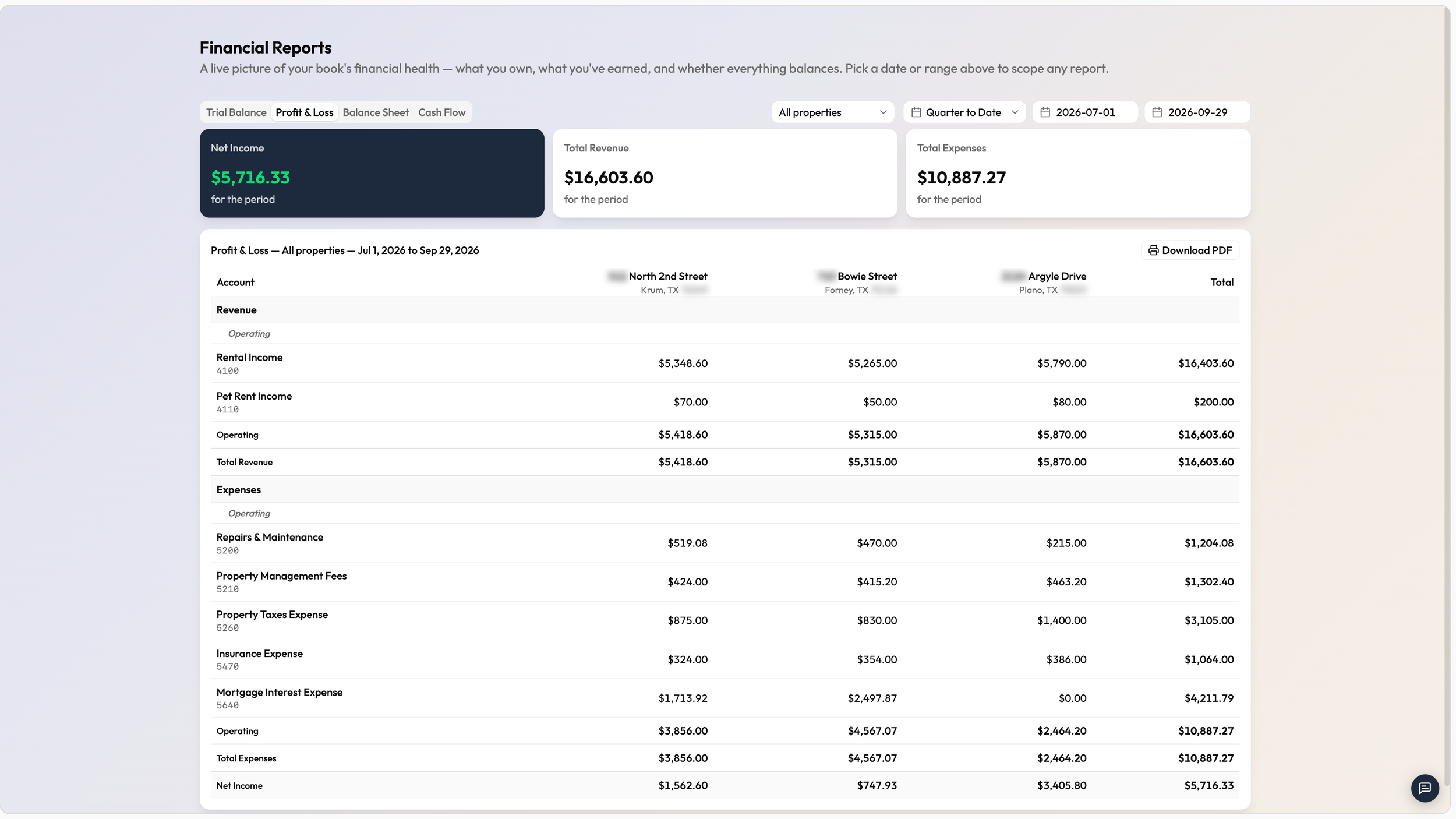
From those records, the platform creates GAAP double-entry books at both the property and portfolio level, including profit-and-loss statements, balance sheets, and trial balances. The accounting structure also adapts to whether an owner self-manages or uses a third-party property manager, giving the landlord something many smaller portfolios have historically lacked: a continuously maintained financial picture of the entire portfolio.
Reading the Portfolio
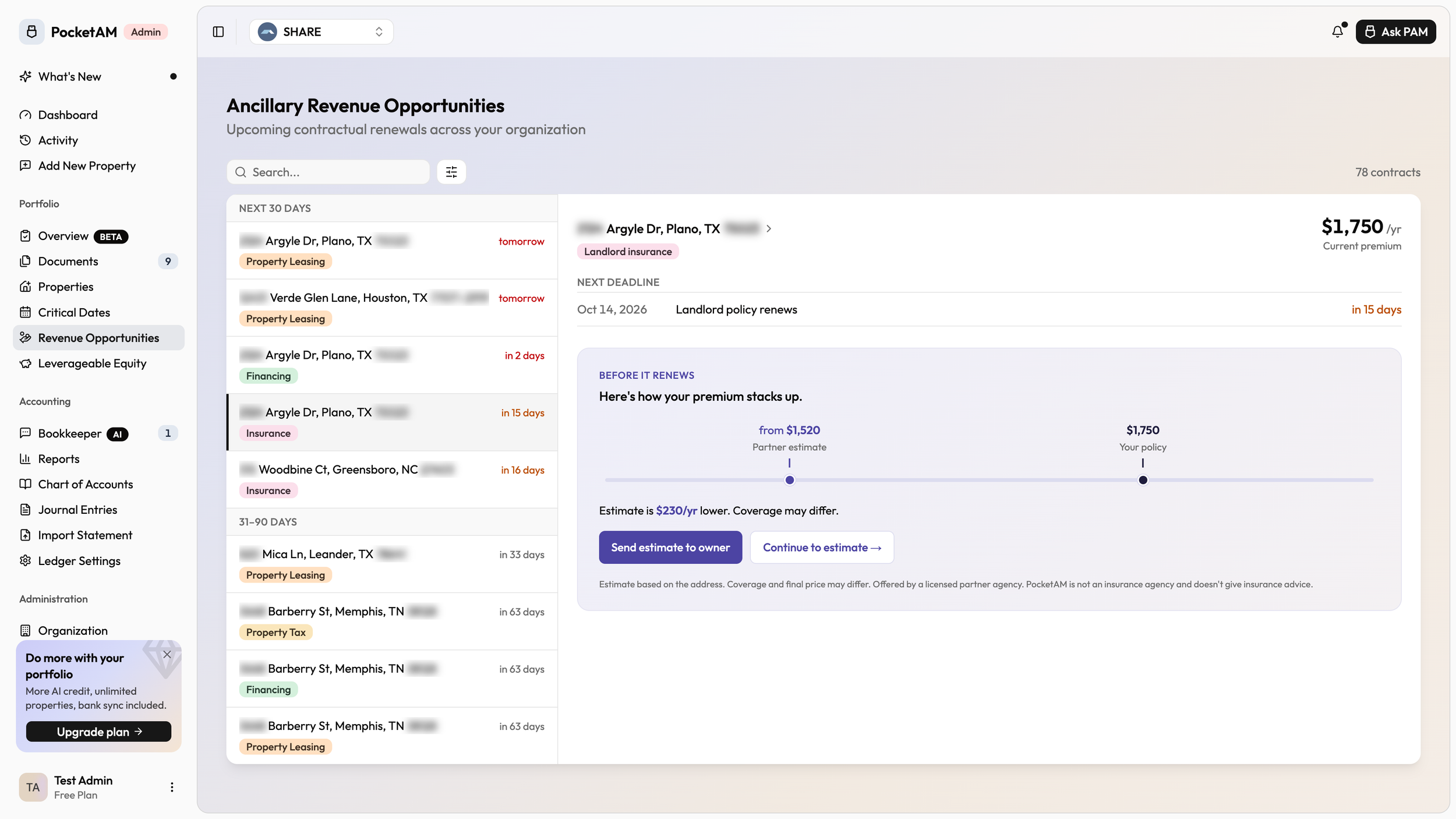
Accounting, however, is only the foundation. It tells an owner what happened. Asset management asks what should happen next.
PocketAM combines the owner's private records with public and market information and applies asset-management logic developed from SHARE's experience across more than $7 billion of real estate portfolios. Rather than simply making documents searchable, the system attempts to identify situations where the underlying information suggests an owner should act.
An approaching insurance renewal, for example, is more useful when the current premium can be evaluated against alternatives. A property that has appreciated while its mortgage balance declined may contain equity capable of supporting another acquisition. Cash reserves become more meaningful when evaluated against upcoming taxes, insurance premiums, debt payments, and capital expenditures.
This changes the role of the software. Instead of answering only, "What does my portfolio look like?" the more valuable questions become, "What is costing me more than it should?" and "Where can this portfolio grow?"
From Property Management to Asset Management
Property management and asset management are often treated interchangeably by smaller landlords, but institutional real estate draws a clear distinction between them. Property management focuses on operating the building: collecting rent, coordinating repairs, managing residents, and maintaining the property. Asset management focuses on the owner's capital: financial performance, financing, risk, expenses, and the decisions required to improve long-term returns.
Individual landlords need both functions, but historically only one has been economically scalable. A professional asset manager cannot spend hours every month evaluating refinancing opportunities, insurance costs, tax assessments, and capital allocation for an owner with three houses. AI changes that cost structure by allowing documents to be continuously interpreted and potential actions surfaced without requiring an analyst to rebuild the portfolio every time something changes.
The opportunity is not necessarily to eliminate the professionals already surrounding the landlord. A refinancing still requires a lender, taxes may require an accountant, and insurance requires appropriate professional expertise. The asset-management layer instead determines when those specialists should become involved and gives the owner enough context to act.
Turning Properties Into a Balance Sheet
Institutional investors rarely think about properties exclusively as individual assets. They also view the portfolio as a balance sheet. Equity accumulated in one property can support another acquisition, debt can be repriced, insurance can be managed across the portfolio, and capital expenditures can be planned against available liquidity.
Small landlords frequently operate property by property because almost every participant in the ecosystem interacts with them that way. They finance one acquisition, insure one building, pay one tax bill, and eventually sell one property. An owner with several houses and substantial accumulated equity may therefore never think of themselves as managing a multimillion-dollar real estate portfolio, even though economically that is exactly what they own.
PocketAM's larger opportunity is making that balance sheet visible. Once the properties can be understood collectively, decisions that previously appeared isolated become capital-allocation decisions across a portfolio.
Distribution Through the Existing Ecosystem
The fragmentation surrounding landlords also creates a natural distribution opportunity. The same organizations that currently hold individual pieces of the owner's financial picture are well positioned to help create the complete one.
Property managers could introduce PocketAM during owner onboarding or use it as an oversight layer across portfolios they already manage. Lenders could maintain relationships with borrowers between acquisitions instead of primarily interacting at closing, while associations and listing organizations could offer the platform as a service to members. The owner operates the platform directly, allowing the partner to participate when an actionable financing, insurance, acquisition, or other opportunity emerges.
PocketAM is also free for smaller landlords, including access to its accounting functionality. The model reflects a longer-term thesis: helping an owner understand and improve a small portfolio may eventually help that portfolio become larger, creating a more valuable customer as the owner's needs become increasingly sophisticated.
The Asset Manager in Every Owner's Pocket
Individual landlords already have access to more property data than any previous generation of real estate investors. Home values update automatically, mortgage balances are available online, bank transactions arrive in real time, and property-management platforms record operating activity. The problem is no longer simply obtaining information. It is understanding what all of that information means together.
PocketAM is betting that AI can close that gap. By grounding its analysis in an owner's actual documents and combining those records with market information and institutional asset-management logic, the company is attempting to turn fragmented property records into a continuously monitored portfolio.
The broader shift extends well beyond rental housing. AI is beginning to make professional capabilities available to customer segments that historically could not justify their cost, from accounting and legal analysis to underwriting and asset management. In real estate, that could begin narrowing one of the structural advantages institutional owners have always held over individuals: dedicated people whose job is to continuously look for ways to protect and grow capital.
Institutions have always had someone watching the portfolio. The roughly $4.5 trillion question is what happens when individual owners do too.