Case Study: GrottoAI

Multifamily has spent the past decade investing in technology to improve nearly every stage of the leasing process. Property management systems track availability and applications, revenue management platforms optimize pricing, and AI leasing assistants increasingly handle inquiries, scheduling, and follow-up. Yet one of the most important determinants of leasing performance remains largely unmeasured: the conversations between prospective renters and the people responsible for converting them into residents.
For institutional owners, that represents a significant operational blind spot. A property may generate hundreds of inquiries and dozens of tours, but traditional reporting primarily explains how many prospects moved through the funnel, not why they converted or walked away. As new supply increases competition in many markets and operating budgets remain under pressure, understanding what happens during those interactions is becoming increasingly important to occupancy, leasing efficiency, and revenue performance.
This case study examines the emerging role of conversational intelligence in multifamily through Grotto, an AI-powered sales coaching and intelligence platform for leasing teams. Grotto analyzes interactions with prospective renters, provides guidance during calls, evaluates in-person tours, and transforms conversations into structured intelligence for operators. More broadly, the company represents a shift in real estate technology from automating leasing activity to understanding and improving the human interactions that influence leasing outcomes.
The Leasing Performance Blind Spot
Property owners have become increasingly sophisticated in measuring financial and operating performance. Occupancy, concessions, rents, lead volume, applications, and conversion rates are routinely monitored across institutional portfolios. Despite that visibility, the industry has historically lacked a consistent method for evaluating the quality of individual leasing conversations.
Most operators rely on a combination of secret shopping, manager observations, call recordings, and training programs. Secret shops typically capture only a handful of interactions each year, while managers observe tours when time permits. Call recordings may exist inside tracking systems, but reviewing them requires resources that most operating teams cannot consistently dedicate.
The result is a disconnect between what owners measure and what actually happens at the point of sale. An operator may know that a property has a lower-than-expected tour-to-lease conversion rate without understanding whether the problem is pricing, inventory, competitive positioning, or the leasing experience itself. Correcting the wrong variable can introduce additional costs without addressing the underlying problem.
Grotto's thesis is that conversations should become a measurable operating dataset rather than an activity that disappears once the prospect leaves. By analyzing calls and tours systematically, operators can begin identifying patterns that historically depended on anecdotal observations and limited samples.
When Automation Makes Human Performance More Important
AI is already reshaping the beginning of the renter journey. Increasingly capable leasing assistants can respond to inquiries, answer routine questions, schedule appointments, and maintain follow-up communication without requiring continuous human involvement. That automation reduces administrative work, but it also creates a new competitive dynamic as operators gain access to increasingly similar capabilities.
As initial responses and scheduling become more standardized, differentiation may shift toward the moments when prospective renters interact directly with on-site teams. A renter who has already compared pricing, floor plans, amenities, and reviews arrives with specific questions and expectations. The leasing professional's ability to understand those priorities, explain trade-offs, address objections, and establish trust can influence whether the prospect takes the next step.
This is particularly relevant in markets experiencing greater competition from new deliveries and concessions. Operators cannot always rely on demand to compensate for inconsistent execution, and the cost of an unsuccessful tour extends beyond the immediate lost opportunity. Marketing investment has already brought the prospect to the property, but a weak interaction can prevent that investment from producing a lease.
The implication is that automation and human performance are not opposing priorities. As technology assumes more routine leasing responsibilities, the quality of the remaining human interactions may become a more important differentiator in property-level performance.
The Grotto Approach

Nick Deveau, CEO, GrottoAI
Grotto was developed around a straightforward observation: leasing teams generate thousands of conversations, but nearly all of that information disappears after the interaction ends. Top-performing agents develop effective approaches to identifying renter preferences, building rapport, and handling objections, yet those skills are rarely captured in a format that can be transferred consistently across an organization.
The company approaches leasing performance as a continuous learning system. Grotto analyzes interactions to identify what distinguishes stronger performers, incorporates an operator's own leasing standards, and delivers guidance that agents can use during calls or immediately after tours. Rather than depending exclusively on occasional training sessions, the system attempts to reinforce effective selling behaviors throughout the working day.
Its platform combines three capabilities: real-time call guidance, post-tour coaching, and renter intelligence. Each addresses a different part of the same problem, connecting individual agent performance with a broader understanding of prospective renter behavior.
The larger opportunity lies in the relationship between these functions. Coaching improves individual execution, while the conversations themselves generate information about customer preferences and objections. Over time, that information can inform how teams are trained, how properties are positioned, and how management evaluates leasing performance.
From Training to Real-Time Coaching
Conventional leasing training is typically concentrated around onboarding, periodic workshops, online courses, and management feedback. Those programs establish expectations, but they do not necessarily help an agent navigate a particular conversation with a renter whose priorities are unfamiliar or whose objections are difficult to anticipate. The interval between training and application can be considerable.
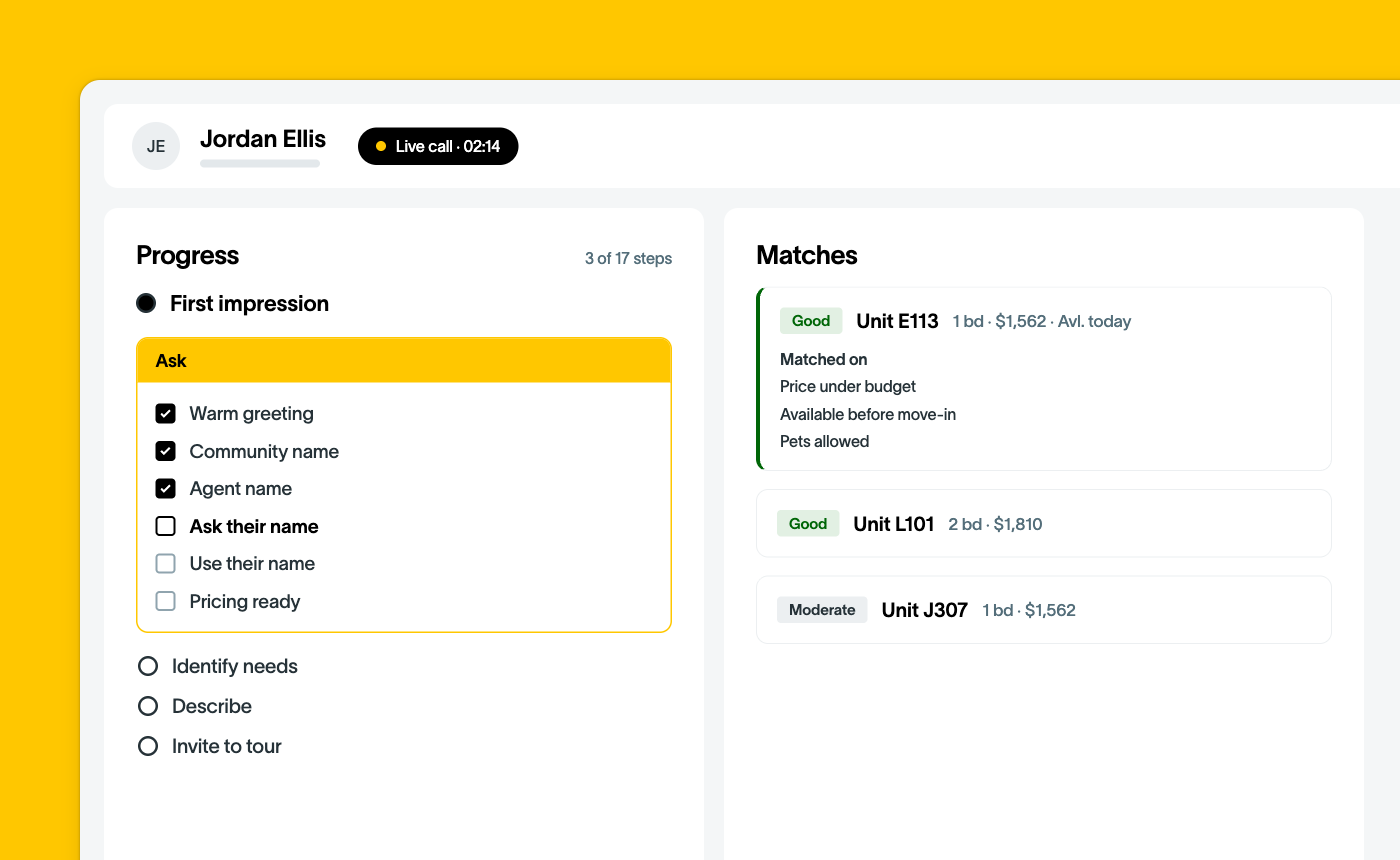
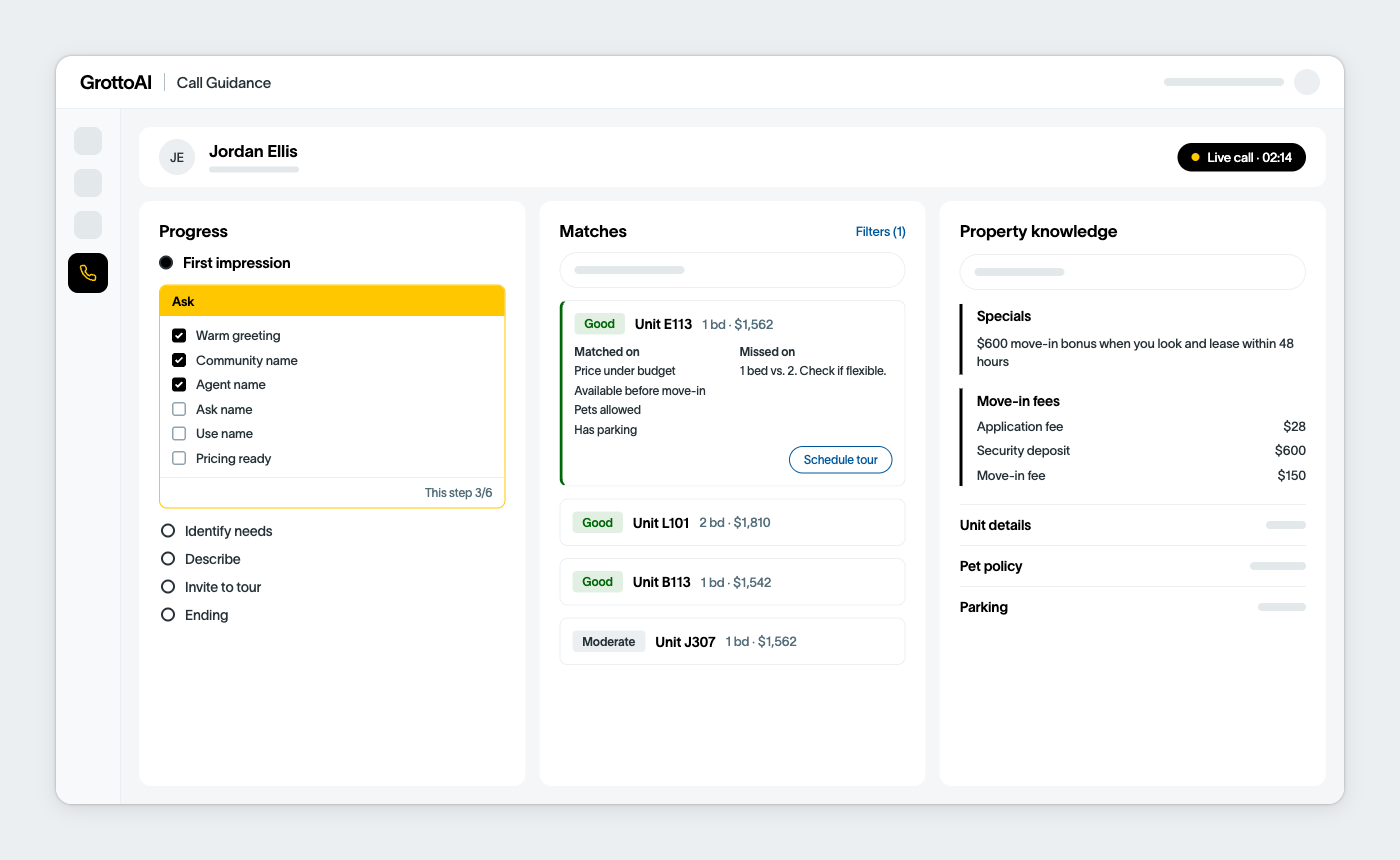
Grotto introduces guidance directly into the interaction. During a leasing call, the platform listens in real time and presents relevant prompts, including questions to ask, information to clarify, potential responses to objections, and available units that may fit the prospect's requirements. Recommendations are informed by property information, the operator's leasing standards, and patterns identified from successful interactions.
The system also captures information such as the prospect's move-in timeline, budget, household requirements, and preferences, transferring those details into the operator's CRM or property management system. The objective is to reduce the administrative burden of note-taking while allowing the agent to focus on the conversation. By the time the renter arrives for a tour, the guest card can already reflect information collected during the initial call.
This changes the timing of coaching. Instead of discovering weeks later that an agent failed to ask an important qualifying question, the system can identify the omission while the conversation is still happening. For operators managing distributed teams, the potential advantage is greater consistency without requiring a manager to monitor every interaction personally.
The Tour as a Source of Intelligence
The property tour is one of the longest and most consequential interactions in the multifamily leasing process. It is also among the least documented. While an operator may track whether a tour occurred and whether the prospect subsequently applied, the actual conversation often leaves little usable information behind.
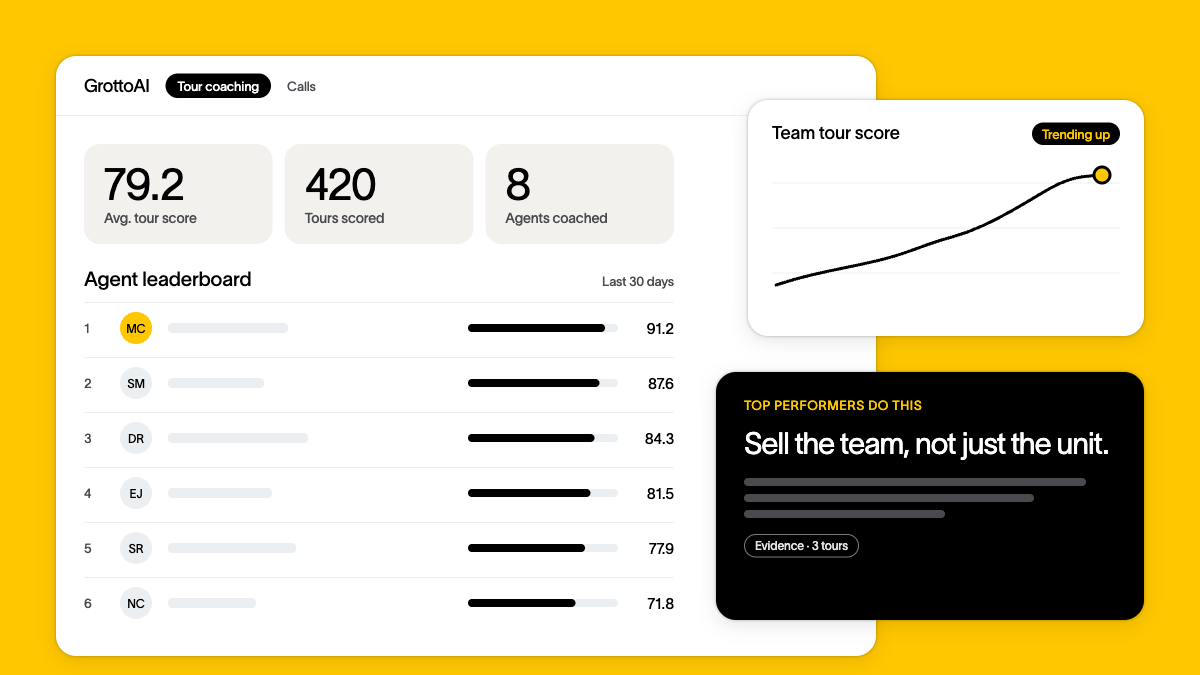
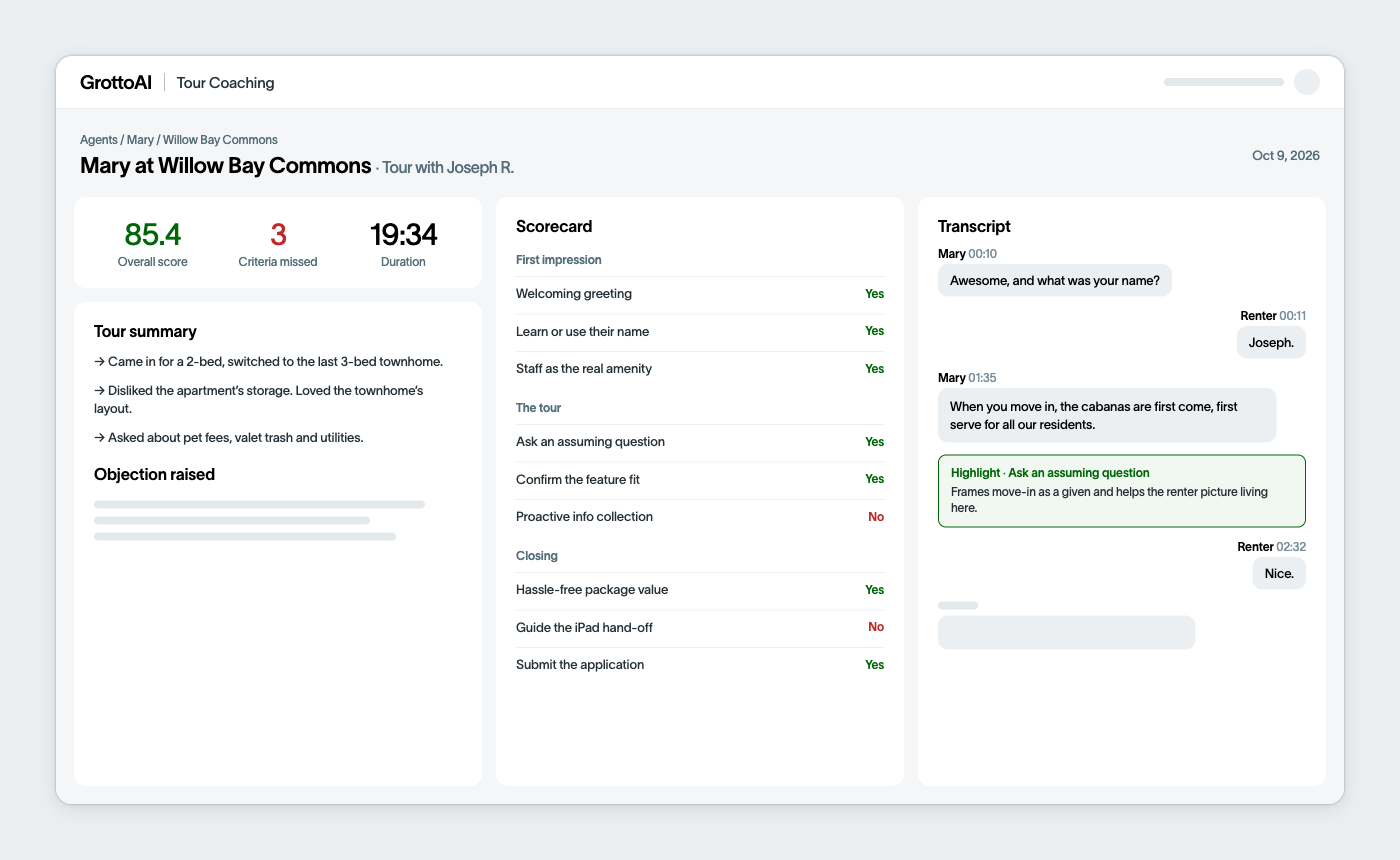
Grotto allows leasing agents to record in-person tours using their phones. The platform transcribes the interaction, evaluates it against the operator's standards, and delivers specific feedback after the prospect leaves. Instead of relying on a manager's occasional observations, the operator can evaluate how consistently agents discover customer needs, explain property features, handle concerns, and establish appropriate next steps.
The operational implications extend beyond agent training. Tours contain detailed information about what renters value, how they compare competing properties, and where a community fails to meet expectations. Price objections, amenity preferences, unit-layout concerns, parking requirements, and location trade-offs all emerge naturally during conversations, but traditional reporting captures only a fraction of that information.
Transforming those interactions into structured data creates an opportunity to connect leasing conversations with decisions made by marketing, revenue management, and asset-management teams. The tour becomes both a sales interaction and a source of market intelligence.
Understanding Why Renters Do Not Lease
Multifamily operators have access to extensive leasing funnel metrics, but those measurements are primarily descriptive. A report may show that 100 prospects toured a property and 20 submitted applications, but it does not necessarily explain what prevented the remaining 80 from moving forward. Without that context, operators may attribute disappointing conversion to the wrong factors.
Grotto's Renter Intelligence capability is designed to aggregate preferences, motivations, competitive comparisons, and objections across calls and tours. Rather than evaluating isolated conversations, the platform allows teams to examine recurring patterns across properties and markets. Those patterns can provide a more complete picture of how renters perceive a community relative to its alternatives.
Consider a property experiencing weaker conversion despite competitive rents and strong inquiry volume. Traditional reporting may encourage more advertising, increased concessions, or additional leasing training. Conversation analysis could instead reveal that prospects consistently object to a particular floor plan, compare the property's parking unfavorably with nearby communities, or misunderstand the value of an amenity included in the advertised rent.
Those findings would support different operating responses. Marketing could adjust its positioning, leasing teams could address recurring concerns earlier, and asset managers could evaluate whether the problem requires a physical improvement or a change in pricing strategy. The value comes from connecting qualitative renter feedback to decisions that affect financial performance.
The Economics of Leasing Performance
Even modest differences in leasing conversion can influence property economics. When a prospect fails to convert, the operator may need to spend more on marketing, extend the time required to fill a unit, or provide additional concessions. Depending on market conditions, those effects can translate into greater vacancy loss and pressure on effective rental income.
Improved coaching alone does not guarantee higher conversion, and Grotto's supplied materials do not establish a quantified relationship between its platform and property-level NOI. Its economic proposition, however, is testable. Operators can evaluate changes in call-to-tour and tour-to-lease conversion, time to productivity for new hires, coaching hours, and the effectiveness of sales practices across comparable properties.
A second potential benefit concerns management capacity. Property and regional managers already balance staffing, resident operations, budgeting, maintenance, and leasing oversight. Coaching every agent consistently becomes increasingly difficult as responsibilities expand, particularly across larger portfolios.
Automating parts of performance review could allow managers to concentrate their attention where intervention is most valuable. Instead of reviewing a random selection of conversations, they could examine patterns across agents, identify recurring weaknesses, and direct their time toward specific coaching needs. The financial value would depend on measurable improvements in productivity, conversion, or labor efficiency rather than the volume of conversations analyzed.
Standardizing Performance Across Portfolios
Consistency becomes more difficult as operators grow. A management company overseeing dozens or hundreds of communities may operate across different markets, property classes, ownership structures, and stages of lease-up. Acquisitions introduce additional teams and existing practices, making it difficult to maintain common standards.
Traditional training programs can communicate expectations but do not guarantee consistent execution. Regional managers may implement different coaching approaches, while high-performing agents often develop techniques that remain localized within individual properties. When those employees leave, part of the organization's accumulated operating knowledge may leave with them.
Grotto attempts to capture effective selling behaviors and apply them more systematically across the portfolio. By evaluating conversations against defined standards and identifying practices associated with stronger performance, the platform can help operators reinforce a common approach while preserving the flexibility needed for individual prospects and properties.
The potential benefit is organizational rather than merely individual. Leasing expertise becomes less dependent on a small number of experienced employees and more accessible throughout the workforce. For operators facing turnover and staffing constraints, that could improve the speed at which new employees develop productive selling capabilities.
The Value of Proprietary Operating Data
A significant implication of conversational AI is the creation of a dataset that multifamily operators have historically been unable to capture at scale. Financial systems provide information about property performance, and CRM platforms track the movement of prospects through the leasing process. Conversations provide a different category of information: what customers actually say, value, reject, and compare while making a housing decision.
Grotto describes this category as "frontier data," information generated through difficult-to-capture interactions, particularly in-person tours. Unlike pricing data or publicly available property characteristics, this information is generated through an operator's direct relationships with prospective renters. Its potential usefulness increases as individual conversations accumulate into recognizable patterns across properties and markets.
That distinction may become increasingly important as AI capabilities become widely available. Access to conversational models alone is unlikely to provide a durable competitive advantage if competitors can obtain similar technology. The proprietary information those models interpret—and an operator's ability to turn it into better decisions—may be more difficult to replicate.
There are also practical requirements for making this model effective. Operators need reliable recording and transcription, appropriate privacy and consent practices, integration with existing systems, and a method for distinguishing meaningful insights from isolated remarks. Aggregating more conversations is useful only when the resulting intelligence is sufficiently accurate, representative, and actionable.
The Future of Multifamily Leasing
Over the next five years, multifamily leasing is likely to become increasingly divided between automated transactions and human-led decisions. AI will continue to absorb repetitive inquiries, scheduling, follow-up, and administrative tasks, while property teams remain responsible for helping renters navigate one of their most consequential household decisions. The industry's next challenge may be less about automating additional interactions and more about improving the quality of those that remain.
That evolution could change how institutional owners evaluate leasing operations. Rather than measuring performance exclusively through funnel activity and final lease outcomes, operators could begin examining the underlying behaviors and renter preferences that explain those results. Conversations that historically disappeared after each tour could become a continuous source of information for pricing, marketing, training, and capital planning.
Grotto represents an early example of that shift, but the investment case requires evidence beyond technological capability. The company's supplied materials describe its approach and intended operating benefits, but do not provide independently validated conversion improvements, customer case studies, or property-level financial results. For owners evaluating the category, the relevant questions concern measurable leasing outcomes, implementation requirements, employee adoption, and whether the resulting intelligence changes decisions in ways that improve portfolio performance.
The broader opportunity is nevertheless significant. Multifamily has built sophisticated systems to measure what happens before and after the leasing conversation, while leaving the interaction itself largely unexamined. As AI makes those conversations measurable, the industry gains an opportunity to connect renter behavior, employee performance, and asset economics more directly.
The next competitive advantage in multifamily leasing may not come from answering more inquiries or generating more tours. It may come from understanding what happens during those conversations—and using that knowledge to make every subsequent interaction better.